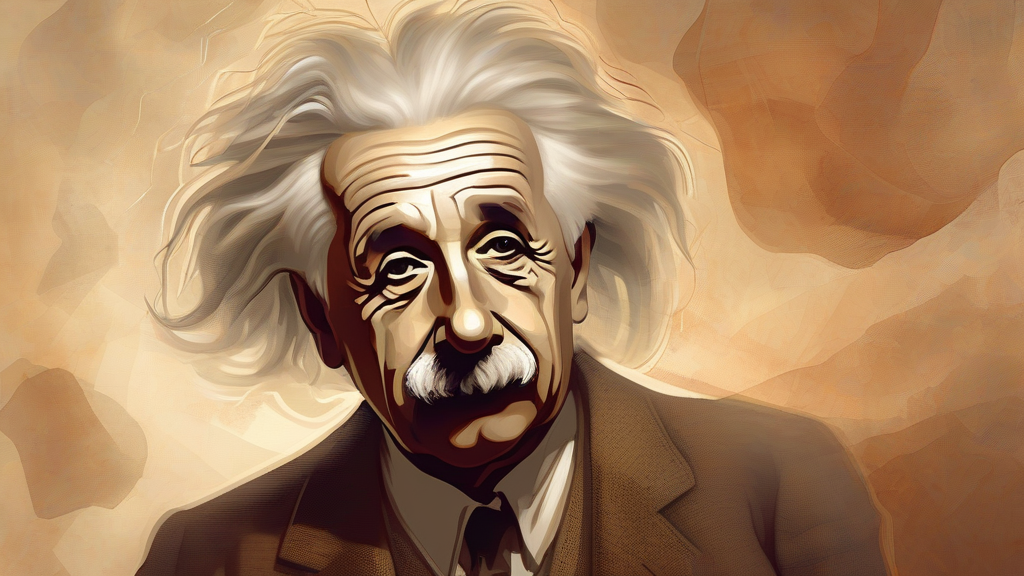
What does einstein mean?
Albert Einstein was a German-born physicist who is widely regarded as one of the most influential scientists of the 20th century. He is best known for his theory of relativity, which challenged the long-held notion of absolute time and space. Einstein's work on the photoelectric effect led to the development of quantum mechanics, and his famous equation E=mc² has become a cultural icon. Einstein's legacy extends beyond his scientific contributions, as he was also a passionate advocate for peace, civil rights, and social justice. His name has become synonymous with genius and intellectual curiosity, and his ideas continue to inspire new generations of scientists, philosophers, and thinkers.
Albert Einstein, the German-born physicist and philosopher.
"Einstein's theory of relativity revolutionized our understanding of space and time."
A unit of energy, equal to the energy required to move a particle of mass 1 kilogram by 1 meter per second squared, named after Albert Einstein.
"The energy released by the nuclear reaction was measured in units of Einstein."
Reviewed by Deb Chak, Editor. AI-assisted content curated by RJS Tech Solutions LLP.
Etymology of einstein
The name 'Einstein' is derived from the German words 'Ein' meaning 'one' and 'Stein' meaning 'stone'. Albert Einstein was born in 1879 in Munich, Germany, and grew up in a middle-class Jewish family. He developed an interest in science and mathematics at an early age and went on to study physics at the Swiss Federal Polytechnic University.
Usage notes
The name 'Einstein' is often used as a synonym for genius or intellectual curiosity. It is also used as a unit of energy in physics and engineering.