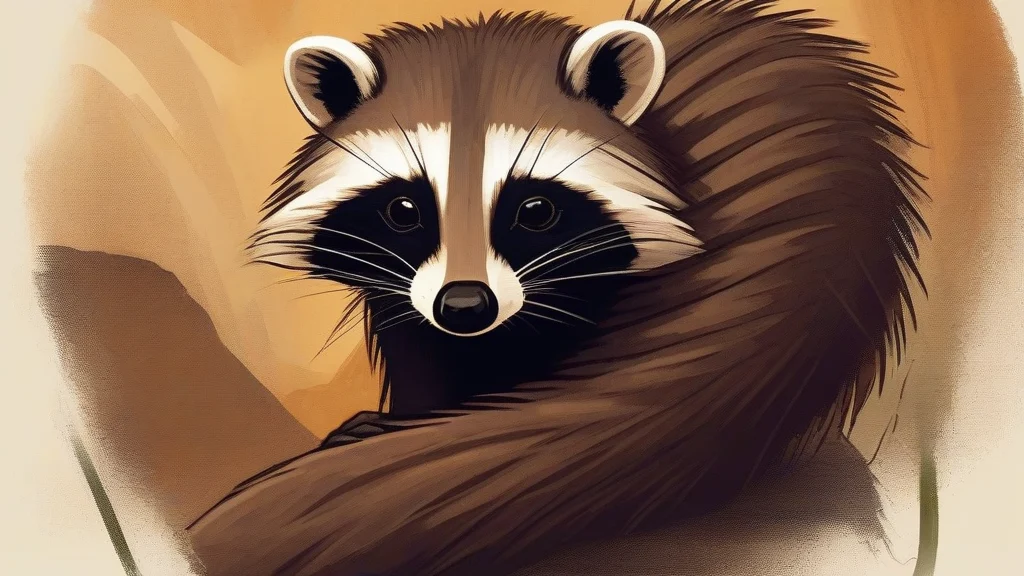
What does coatimundi mean?
A coatimundi is a mammal belonging to the raccoon family, Procyonidae, found from southern Mexico through Central America into South America. It has a slender body, a long flexible snout used for rooting out food, and a distinctive ringed tail often carried erect. Coatimundis are highly social and omnivorous, living in troops that forage for insects, fruit, eggs, and small animals. The name derives ultimately from indigenous South American languages via Portuguese, and it functions as an alternative English common name alongside 'coati', which many zoologists now prefer. The word appears most often in nature writing, travel accounts, zoo signage, and wildlife documentaries rather than everyday conversation, giving it a somewhat specialist flavor. For readers encountering it in print, it reliably signals an encounter with the fauna of Neotropical forests — an animal familiar enough to local communities yet exotic-sounding to most English speakers, which helps explain its enduring appeal in descriptive prose.
nounA coatimundi is a raccoon-like mammal of the genus Nasua, native to Central and South America and southern Mexico, with a long ringed tail, elongated snout, and omnivorous habits; the term is also used as an alternative common name for the coati generally.
- A raccoon-like mammal of the genus Nasua (or related Nasuella) native to the Americas, with a long ringed tail, elongated snout, and omnivorous diet.
- An alternative common name for the coati in general.
"The coatimundi foraged along the forest floor, its long tail held upright as it rooted through leaf litter with its flexible snout."
"Visitors to the Costa Rican rainforest often see a coatimundi troop crossing the trail at dawn."
"In captivity, a coatimundi can live over fifteen years on a varied diet of fruit, insects, and small vertebrates."
The regular plural 'coatimundis' is standard. Some writers use 'coatis' when referring to the same animals under the broader name; both plurals are accepted, but consistency within a text is advisable.
"Troops of coatimundis can number twenty individuals or more."
Despite the '-mundi' ending, coatimundi has nothing to do with Latin 'mundus' — it comes from Tupi words meaning roughly 'belt' or 'band' plus 'nose', describing how males rub scent on their bellies.
Reviewed by Deb Chak, Editor. AI-assisted content curated by RJS Tech Solutions LLP.
Etymology of coatimundi
The word 'coatimundi' entered European languages through Portuguese, borrowing from Tupi, an indigenous language family of Brazil. Its elements are commonly analyzed as combining terms relating to a belt or band and the nose, a reference possibly connected to the animal's markings or behavior. The form was adopted into English by the early nineteenth century as naturalists catalogued South American fauna. It stands alongside the shorter 'coati', itself also borrowed via Portuguese from Tupi, which remains the more widely used common name today.
How coatimundi is actually used
The word is informal-to-technical in register: it appears frequently in zoological writing and wildlife tourism contexts. In modern scientific and popular usage, 'coati' is generally preferred as the standard common name; some sources reserve 'coatimundi' for the typically solitary adult male. The plural is usually 'coatimundis', though 'coatis' is more common overall.
Easily confused with coatimundi
Coati is the standard English common name for these animals (Nasua and Nasuella), while coatimundi is a variant name derived from a Tupi word that is sometimes applied specifically to solitary adult males.
Raccoons are North American procyonid mammals with black facial masks, whereas coatimundis are their more slender-snouted, longer-tailed Central and South American relatives without a mask.