
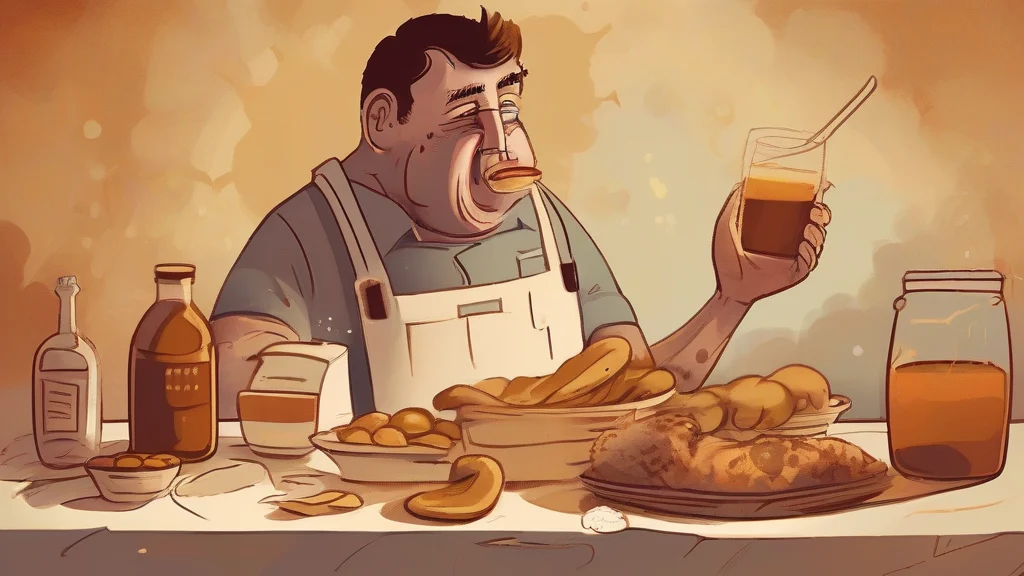
What does crapulousness mean?
Crapulousness is a noun denoting the state or quality of gross overindulgence in food or drink, together with the heavy, sickened condition it produces. It is derived from the adjective 'crapulous', which traces back through Latin crapula — meaning intoxication or the headache that follows drinking — to the ancient Greek kraipalē, a word for hangover. In modern use, crapulousness is rare and distinctly literary or humorous in register, appearing most often in historical fiction, satirical writing, or erudite commentary on excess. Its connotations are firmly negative, implying not merely festive overindulgence but a blunting, debased condition brought on by repeated excess. A sentence such as 'a general air of crapulousness hung over the court' evokes both physical aftermath and moral judgment. Though seldom encountered, it offers writers a precise, vividly Latinate alternative to plainer terms like drunkenness or gluttony, bundling both the cause and the miserable consequences of overindulgence into a single expressive noun.
nounThe state or quality of being crapulous; excessive indulgence in food or drink, especially the sick, bloated condition resulting from overeating or drunkenness.
- The state of being given to, or suffering the effects of, excessive eating or drinking; gross intemperance.
"He awoke on the sofa, his head throbbing with the crapulousness of the previous night's celebrations."
"The morning after the banquet, a general air of crapulousness hung over the entire household."
"Critics accused the regime's elite of a crapulousness that blinded them to the suffering of ordinary citizens."
As an uncountable abstract quality, the plural is rare and generally avoided; when quantifying instances, writers more often speak of 'acts of crapulousness' or simply use the singular.
"The diaries record each of the young prince's crapulousnesses with disapproving precision."
This word descends from the ancient Greek kraipalē — which meant not 'excess' but the hangover itself, making crapulousness one of the oldest hangover words in the Western world.
Reviewed by Deb Chak, Editor. AI-assisted content curated by RJS Tech Solutions LLP.
Etymology of crapulousness
Crapulousness derives from the adjective 'crapulous', which entered English in the sixteenth century via Latin crapula, meaning intoxication or the sickness following a bout of drinking. The Latin term was itself borrowed from Greek kraipalē, which denoted the headache and nausea of a hangover. The noun suffix '-ness' formed the abstract quality-word, placing crapulousness among a small family of English derivatives that also includes 'crapulence' and 'crapulent'.
Related word forms
How crapulousness is actually used
A rare, formal, and somewhat humorous or literary word, found mainly in older or deliberately ornate prose. It carries a strongly negative, disapproving connotation of self-indulgence. It is far less common than its adjective relative 'crapulous'.
Easily confused with crapulousness
Crapulence refers to the act or state of excessive eating and drinking itself (or its attendant sickness), while crapulousness denotes the quality or condition of being crapulous.
Crapulous is the adjective describing someone suffering from such excess, whereas crapulousness is the noun naming that condition abstractly.