What does cubistic mean?
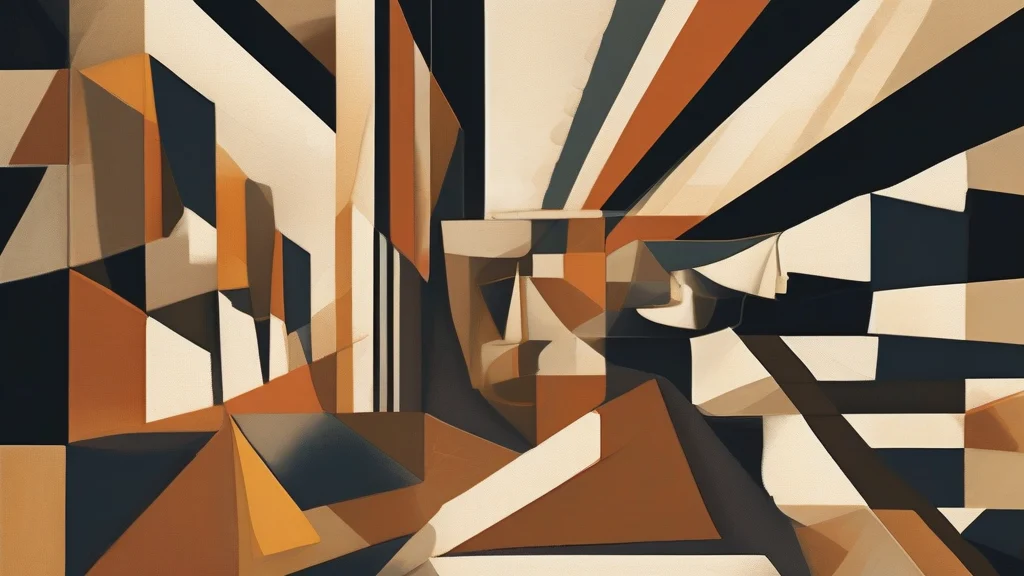
Cubistic is an adjective describing anything related to or characteristic of Cubism, the revolutionary art movement that emerged in Paris around 1907 through the work of Pablo Picasso and Georges Braque. A cubistic painting or sculpture abandons single-point perspective: instead of showing a subject from one fixed viewpoint, it breaks the subject into geometric facets and presents multiple angles at once, flattening depth into interlocking planes of muted colour. The term can also describe architecture or design that echoes this angular, fractured aesthetic. Because it functions strictly as an adjective, one speaks of a cubistic composition rather than calling an artist simply "cubistic"; for people, the noun "Cubist" is standard. The word appears chiefly in art criticism, museum writing, and academic discussion, where it offers a slightly more descriptive alternative to "Cubist" when characterizing the qualities of a work rather than attributing it to the movement itself.
adjectiveRelating to or characteristic of Cubism, the early 20th-century avant-garde art movement pioneered by Pablo Picasso and Georges Braque in which subjects are broken into geometric, fragmented forms shown from multiple viewpoints simultaneously.
- Of or relating to Cubism, the early 20th-century art movement characterized by fragmented, geometric depiction of subjects from multiple viewpoints.
- Resembling or evoking the fractured, angular style of Cubist art.
"The gallery's latest acquisition features a strikingly cubistic rendering of a violin, its planes fractured across the canvas."
"Her cubistic portrait reduced the sitter's face to overlapping planes of grey and ochre."
"The building's cubistic facade, all sharp angles and intersecting volumes, scandalized the neighbourhood when it opened."
"Cubistic" describes an art movement so radical that critics said Picasso painted objects as if he had taken them apart and reassembled them from memory.
Reviewed by Deb Chak, Editor. AI-assisted content curated by RJS Tech Solutions LLP.
Etymology of cubistic
The adjective "cubistic" derives from "Cubism," the name coined around 1908–1909 after French critic Louis Vauxcelles reportedly described Braque's landscapes as reducing everything to "geometric outlines, to cubes." "Cubism" itself combines "cube" with the French suffix "-isme," denoting a doctrine or movement; the noun "cube" traces back through French and Latin "cubus" to Greek "kybos." English speakers formed "cubistic" by adding the adjectival suffix "-ic" to the movement's name, following the same pattern seen in words such as "realistic" and "impressionistic."
Related word forms
How cubistic is actually used
The word is used almost exclusively in discussions of art and art history; it is somewhat less common than "Cubist" used adjectivally (as in "a Cubist painting"), and carries no figurative or informal usage. Capitalization varies: "Cubistic" is often capitalized in art-historical writing, while lowercase "cubistic" appears frequently in general prose.
Easily confused with cubistic
"Cubist" most often denotes a person who practised Cubism or the style itself as a noun, while "cubistic" is purely adjectival, describing anything having Cubism's characteristics.