
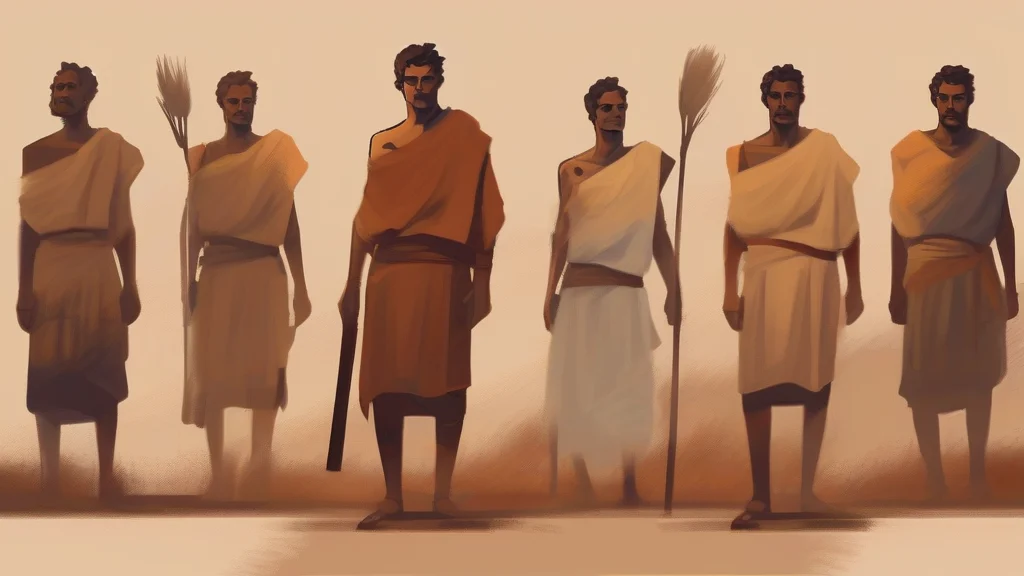
What does exomis mean?
The exomis was the everyday work garment of ancient Greece: a short tunic worn by farmers, potters, smiths, slaves, and soldiers who needed freedom of movement. Its defining feature was that it was fastened over only one shoulder — usually the left — leaving the right arm and shoulder bare, an arrangement that kept fabric out of the way during physical labour. Typically made of undyed wool or linen and belted at the waist, it contrasted with the longer, more formal chiton worn for public or ceremonial occasions. The word appears chiefly in classical scholarship, archaeology, and art history, where scholars use it to identify figures of workers on painted pottery and sculpture. Although obsolete as actual dress, the exomis remains useful vocabulary for anyone reading about Greek daily life, costume history, or the visual culture of the ancient Mediterranean.
nounAn exomis is a short tunic worn by ancient Greek labourers, craftsmen, and soldiers, fastened at one shoulder so as to leave the other arm free for work.
- A short tunic worn by ancient Greek labourers, artisans, and soldiers, leaving one shoulder free.
"The vase painting shows a blacksmith at his forge, dressed only in a rough exomis suited to manual work."
"Farmers and potters alike wore the simple exomis while going about their daily toil."
"The museum's exhibit pairs a terracotta figurine of a labourer with a reconstructed exomis."
The plural follows the Greek pattern (exomides), though anglicized forms are occasionally seen in informal scholarly writing; the word is rare enough that either may be met.
"Several exomides are depicted on the frieze of working figures."
Ancient Greece's most practical garment left one shoulder bare on purpose — so workers could swing a hammer without snagging their clothes.
Reviewed by Deb Chak, Editor. AI-assisted content curated by RJS Tech Solutions LLP.
Etymology of exomis
The word comes from ancient Greek ἐξωμίς (exōmis), formed from ἐξ (ex-, 'out of, outside') and ὦμος (ōmos, 'shoulder'), literally 'off-the-shoulder' — a direct reference to how the garment left one shoulder exposed. It entered English through classical scholarship describing Greek costume. The prefix ex- connects it to a broad family of English words borrowed from Greek, such as exotic, exodus, and exogamy, though these are cognates rather than descendants of the same garment.
How exomis is actually used
A scholarly or archaeological term, encountered almost exclusively in discussions of ancient Greek dress, art history, and classical literature; it does not occur in everyday modern speech.
Easily confused with exomis
A chiton was a fuller-length Greek garment typically worn by both sexes and pinned or sewn along both sides, whereas the exomis was the shorter, single-shouldered working tunic of labourers.