
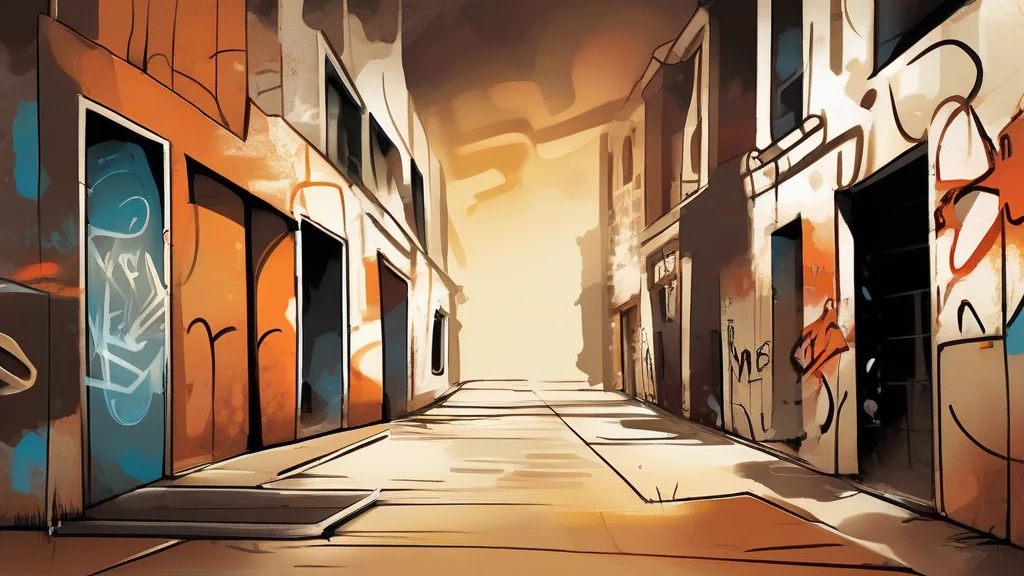
What does graffito mean?
Graffito denotes an individual piece of writing, drawing, or marking made on a wall, pavement, vehicle, or other surface. It is the singular counterpart of graffiti, which is also used collectively for such work and is the form most people encounter. The word is especially common for spray-painted words, symbols, and designs on public surfaces, often made without authorization. In such contexts it can imply vandalism and damage, although graffiti may also describe commissioned murals or pieces created for legal cultural events. A graffito can also mean an inscription scratched or cut into stone or another hard material. Style and subject matter matter: "political graffiti" suggests slogans, while "graffiti artist" identifies someone who creates such work. Although the form graffito is precise for one piece, writers often use graffiti in a mass or collective sense. The expression is now firmly established in British and American English, even though its form reflects Italian origins.
nounAn individual piece of writing, drawing, or marking made on a public or other surface, especially without authorization. By extension, it may refer to an inscription scratched or cut into stone or another hard material.
- An individual piece of writing, drawing, or marking made on a public or other surface, especially without permission; by extension, a piece of graffiti.
"A line of verse added to the wall as graffito gave the neglected alley a surprising sense of intimacy."
"A stylized bird had been added as graffito to the concrete overpass."
"The curator treated each fading graffito as a fragment of the neighborhood's history."
Graffiti is the usual plural and is also used collectively or as a mass noun. The alternative plural graffitos is accepted in some dictionaries but is uncommon.
"The walls were covered with graffiti, each layer telling a different part of the neighborhood's story."
One graffito, many graffiti: the unusual plural preserves the word's Italian ancestry.
Reviewed by Deb Chak, Editor. AI-assisted content curated by RJS Tech Solutions LLP.
Etymology of graffito
English borrowed graffito from Italian in the 17th century. The Italian word derives from graffiare, "to scratch," and ultimately from the Latin graphium, a stylus associated with the Greek verb graphein, "to write." Its early sense referred to writing scratched or cut into a surface, while modern usage also includes painted, sprayed, and drawn markings, especially those made in public places. Related words sharing the Greek root include graph, epigraph, autograph, and paragraph.
Related word forms
How graffito is actually used
The singular is less common than the plural graffiti, which can function collectively or as a mass noun. In contemporary usage the word often implies unauthorized or vandalistic marking, although it can also include commissioned murals and work created for legal cultural events.
Easily confused with graffito
A graffito is one individual piece, while graffiti is the usual plural and may also be used collectively for writing and drawings on surfaces.