
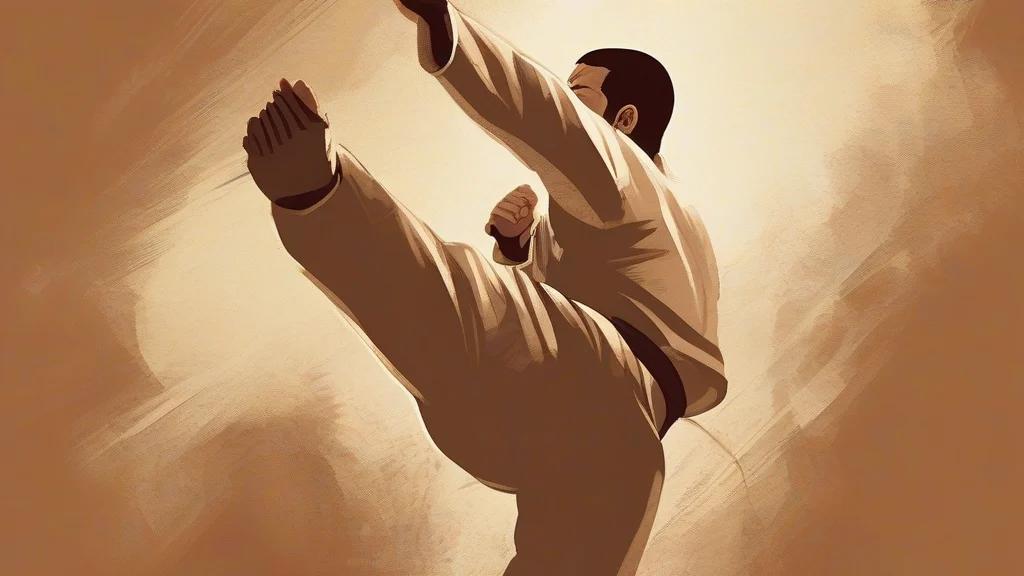
What does jiujitsu mean?
Jiujitsu is a martial art based on controlling an opponent through grappling, leverage, throws, joint locks, and submission holds. In contemporary English, it usually means Brazilian jiu-jitsu, a system that developed from Kodokan judo and became especially prominent through sport competition, self-defense instruction, and mixed martial arts. Its practice emphasizes positioning, balance, timing, and efficient use of force rather than strength alone. A related but broader Japanese term, jujutsu, covers a wider historical family of combat techniques. Although the spellings jiujitsu and jiu-jitsu are both common, the former is often used in English descriptions of the Brazilian grappling art. Jiujitsu is also culturally significant as a discipline that develops technical skill, confidence, and controlled physical contact, while its competitive forms require effective grappling against resisting opponents.
nounA Japanese martial art centered on grappling, joint locks, throws, and submission holds. The term is now most commonly associated with Brazilian jiu-jitsu, a style that evolved from Kodokan judo and emphasizes ground fighting and controlled submissions.
- A martial art emphasizing grappling, throws, joint locks, and submission techniques, especially the Brazilian form derived from judo.
- The broader historical practice of Japanese jujutsu, particularly when the term appears in older English-language usage.
"She has trained in jiujitsu for a decade and now teaches beginner classes at a local martial-arts school."
"The demonstration showed how leverage and positioning can make a smaller practitioner effective in jiujitsu."
"Classical martial-arts texts sometimes use jiujitsu as a historical name for jujutsu, although modern usage usually associates it with Brazilian jiu-jitsu."
The name of the martial art is normally treated as singular or uncountable. Plural forms such as jiujitsu practitioners and jiujitsu tournaments are used when referring to multiple people or events.
"The club has trained several jiujitsu practitioners for regional competitions."
Jiujitsu turns the apparent advantage of a larger opponent into an opportunity to control distance, movement, and leverage.
Reviewed by Deb Chak, Editor. AI-assisted content curated by RJS Tech Solutions LLP.
Where does jiujitsu come from?
The English word comes through Portuguese jiujitsu, a form associated with Japanese jujutsu. The underlying Japanese expression is usually analyzed as jū, meaning “gentle” or “soft,” and jutsu, meaning “art,” “skill,” or “technique,” reflecting the preference for yielding, leverage, and controlled force. The Portuguese form became especially influential through Brazil's adoption and development of judo, eventually giving rise to Brazilian jiu-jitsu.
Related word forms
How jiujitsu is actually used
The spelling is common in English-language discussions of Brazilian jiu-jitsu, while the alternative spelling jiu-jitsu is also widely established. Outside Brazilian-jiu-jitsu contexts, the word may refer more broadly to jujutsu, particularly in older sources.
Easily confused with jiujitsu
Jiujitsu usually refers to the Brazilian grappling system associated with judo, whereas jujutsu broadly denotes the older Japanese family of armed and unarmed combat arts.