
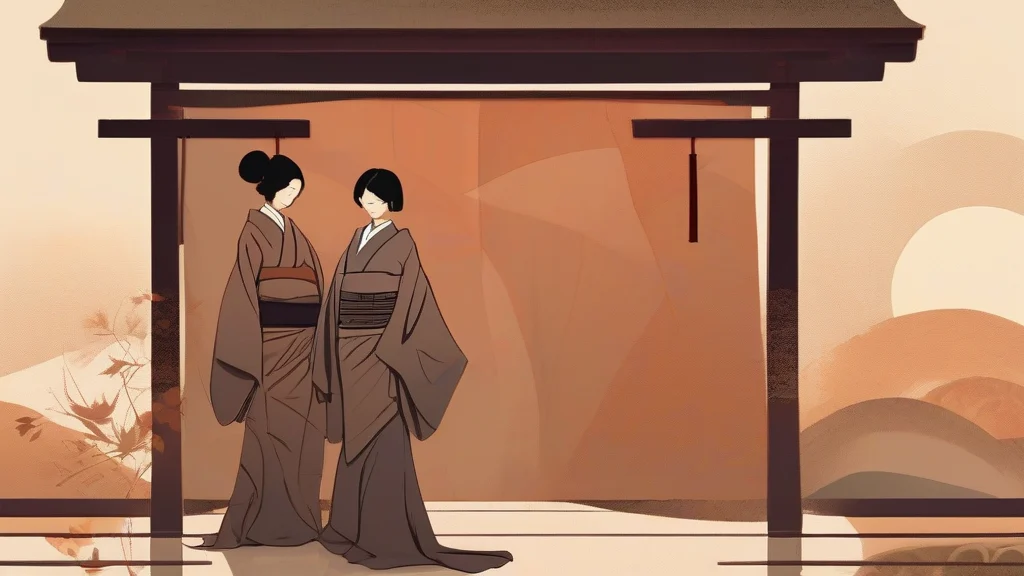
What does kimono mean?
A kimono is a traditional Japanese garment, most often recognized as a long, pleated robe wrapped around the body and secured with a sash called an obi. Unlike an ordinary robe, a kimono has distinctive construction, fabric, patterns, and accessories, and it is commonly associated with formal ceremonies, festivals, weddings, and other culturally significant occasions. The term can also refer more broadly to contemporary clothing inspired by Japanese dress. In English, kimono usually retains a Japanese cultural specificity, even when used to describe a modern or informal garment. Its visual associations include flowing fabric, elaborate patterns, and carefully arranged folds. The word comes from Japanese, where 着物 combines elements meaning “to wear” and “thing,” literally describing a “thing to wear.” The garment has become internationally recognizable as a symbol of Japanese tradition, while its style continues to influence fashion and costume design.
nounA traditional Japanese garment consisting of a long, usually pleated robe that is wrapped around the body and secured with a sash called an obi. Kimonos are worn for formal occasions, cultural ceremonies, and other special events.
- A traditional Japanese robe-like garment worn for formal occasions, ceremonies, festivals, or other special events.
- A garment made in the style of a traditional Japanese kimono.
"She wore a silk kimono with an intricately patterned obi to the ceremony."
"At the wedding, the guests arrived wearing elegant kimonos."
"The designer presented a modern coat with kimono-inspired sleeves."
The usual plural adds -s; in general English, the singular and plural are distinguished by context.
"The shop displays ceremonial kimonos from several regions of Japan."
The word kimono literally means “thing to wear,” a fitting description of a garment whose many folds, layers, and sash make it both practical and ceremonial.
Reviewed by Deb Chak, Editor. AI-assisted content curated by RJS Tech Solutions LLP.
Etymology of kimono
Kimono comes from Japanese 着物, read kimono, a compound of 着, “to wear,” and 物, “thing.” The literal sense is therefore “thing to wear.” The word entered English in the nineteenth century as English speakers became familiar with Japanese art, clothing, and culture; related Japanese compounds such as kakemono, bakemono, and minomono preserve the same 物 element meaning “thing.”
Related word forms
How kimono is actually used
In English, kimono most often refers specifically to traditional Japanese dress rather than to a generic robe. It carries cultural and ceremonial associations, although modern fashion may use the word more broadly for Japanese-inspired designs.
Easily confused with kimono
A yukata is a lightweight casual garment, usually made of cotton and worn in warmer weather, whereas a kimono is a traditional formal garment often made from silk or other fine fabric.