
What does okapi mean?
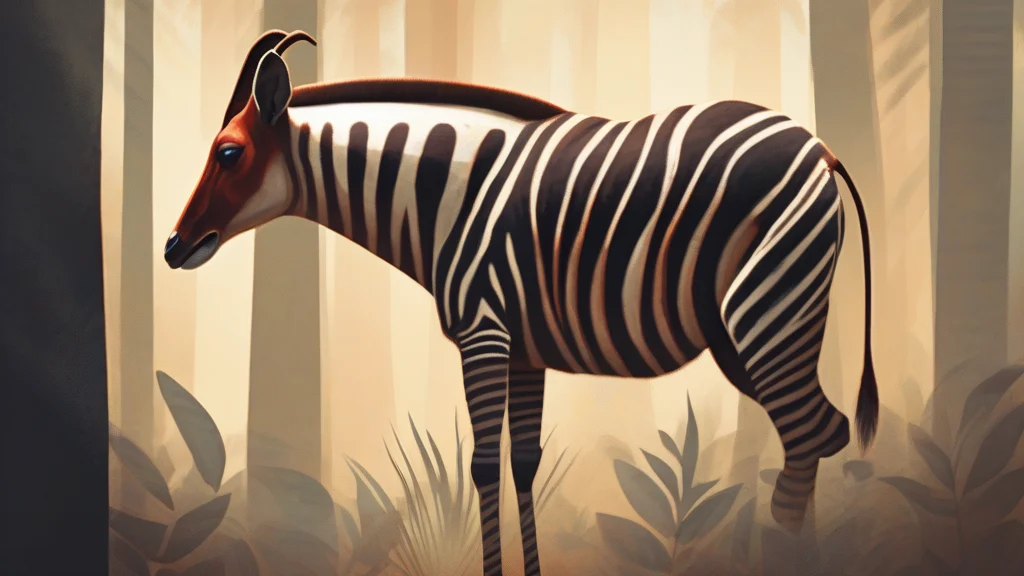
An okapi is a rare, giraffe-like mammal living in the tropical forests of central Africa, particularly the Democratic Republic of the Congo. Although it belongs to the giraffe family, it has a much shorter neck and a distinctly different appearance: its body is reddish brown, while its legs and hindquarters carry bold black-and-white stripes that resemble a zebra's. Okapis are herbivores and are difficult to encounter because they inhabit dense forest and are generally solitary. The name entered English in the early twentieth century through accounts of the animal's scientific identification. In older usage, okapi also referred to a velvet-like fabric, but today the word is overwhelmingly associated with the animal itself. Its combination of familiar features and unusual anatomy makes it one of the most memorable members of the giraffe family.
A large, hoofed, giraffe-family mammal native to the forests of central Africa, with a reddish-brown coat and zebra-like stripes on its legs and hindquarters.
"Researchers used camera traps to document an okapi in a remote forest reserve."
The plural is okapis. The word normally names the species as a whole and can refer to either sex.
A fabric resembling velvet, historically used for clothing and similar goods.
"The museum preserves a coat made from okapi."
This is a historical and uncommon sense in modern English.
Use okapis when referring to more than one animal or to multiple members of the species.
"The conservation team estimated that several okapis remained in the valley."
The okapi looks like a cross between a giraffe and a zebra, but it is its own unique species—and one of the world's most elusive forest animals.
Reviewed by Deb Chak, Editor. AI-assisted content curated by RJS Tech Solutions LLP.
Etymology of okapi
The English word okapi entered use in the early twentieth century as the name of a newly documented central African mammal. The name derives from a local term associated with the animal, as reported by the explorer and colonial administrator Harry Johnston. The animal was formally described scientifically in 1901. No widely established group of cognate English words shares the same root.
How okapi is actually used
In animal contexts, okapi is used for the species, including both males and females. The fabric sense is historical and much less common; modern discussions usually use the word for the animal.
Easily confused with okapi
An okapi is a separate, shorter-necked forest mammal related to the giraffe, not a giraffe itself.
A kouprey is a wild ox found in Southeast Asia, whereas an okapi is a giraffe relative native to central Africa.