
What does orangutan mean?
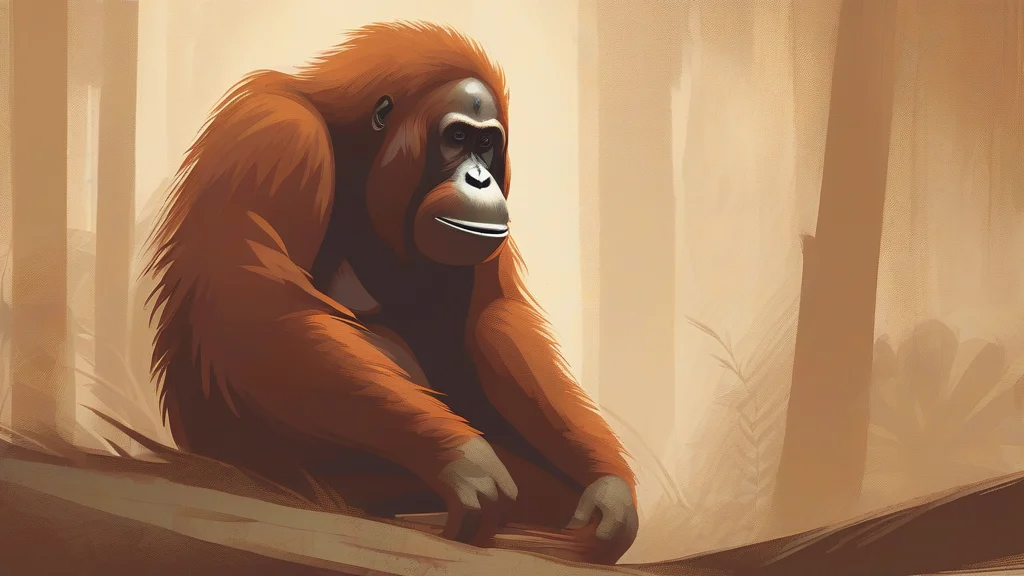
An orangutan is a large great ape native to the rainforests of Borneo and Sumatra. These intelligent, largely arboreal animals have reddish-brown hair, exceptionally long arms, and, in adult males, a prominent throat pouch that can help amplify calls. Orangutans spend much of their lives in the tree canopy, eating fruit, leaves, insects, and occasionally small vertebrates. The word comes from Malay and literally means “person of the forest,” reflecting the close relationship between orangutans and humans, including their use of tools and sophisticated social behavior. Orangutans are threatened by habitat loss and illegal hunting, making their conservation a major concern in Southeast Asia. The word can also be used informally for a hairy, awkward, or seemingly primitive-looking person, although this figurative use may be insensitive or derogatory.
A large, reddish-brown great ape native to the rainforests of Borneo and Sumatra, with long arms and a largely arboreal lifestyle.
"An orangutan was observed building a nest high in the rainforest canopy."
Also written 'orang-utan' in some historical and specialist sources.
Informally, a very hairy, awkward, or brutish-looking person.
"The film portrayed the wrestler as an orangutan."
Informal and potentially derogatory; the zoological meaning is preferred in formal writing.
The standard plural is 'orangutans'; 'orangutans' may also be used attributively, as in 'orangutan habitats.'
"The sanctuary provides rehabilitation for rescued orangutans."
The orangutan's name literally means 'person of the forest' in Malay, a fitting description for one of the world's most intelligent and expressive great apes.
Reviewed by Deb Chak, Editor. AI-assisted content curated by RJS Tech Solutions LLP.
Etymology of orangutan
The English word comes from Malay orangutan, formed from orang, meaning “person” or “human being,” and utan, meaning “forest.” The term entered European usage in the 19th century through accounts of the ape's appearance and behavior. Its Malay components reflect an older observation that the animal shared notable human characteristics, especially its intelligence and expressive gestures.
How orangutan is actually used
In its primary zoological sense, 'orangutan' is precise and widely used internationally. The figurative sense is informal and can sound humorous or derogatory, so it should be used with care.
Easily confused with orangutan
An orangutan is a great ape native to Borneo and Sumatra, whereas a gibbon is a smaller ape of the family Hylobatidae native to tropical Asia.
An orangutan is generally more reddish-haired and arboreal, while chimpanzees are more commonly associated with ground travel and are native to Africa.