
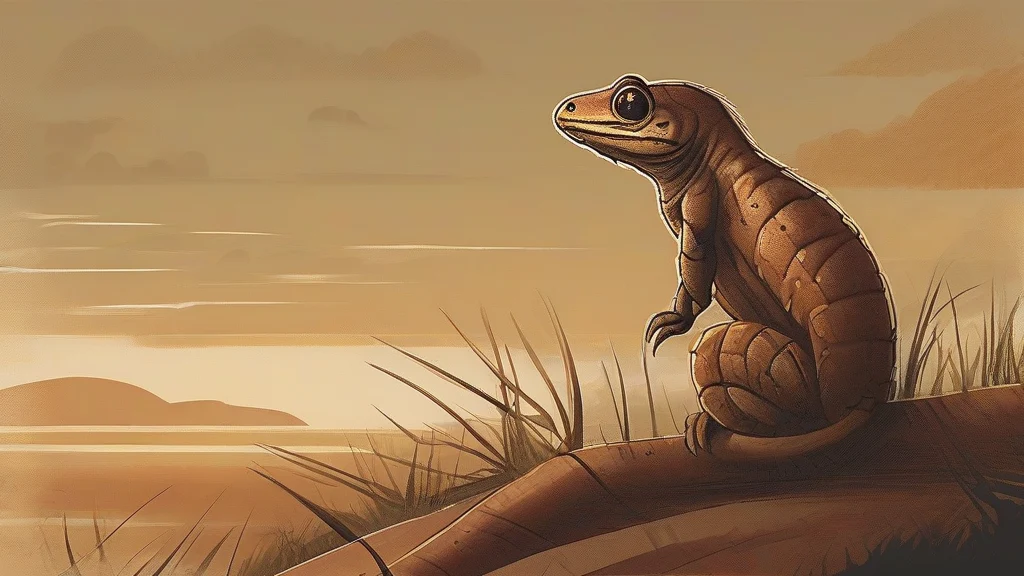
What does reptant mean?
Reptant means moving by crawling or creeping, typically with the body held close to the ground in a manner resembling a reptile. The adjective is most often encountered in biological and zoological writing, where it distinguishes a form of locomotion from flight, swimming, or upright movement. It can describe snakes and lizards moving over a surface, or more generally any creature whose movement is low to the ground. Although its meaning is readily understandable, reptant is formal and literary rather than everyday; in ordinary speech, crawling or creeping is usually more natural. The word is especially useful in descriptions of animal movement because it identifies both the posture and the characteristic mode of locomotion without necessarily naming a particular reptile.
adjectiveCrawling on the belly or moving in a creeping manner, especially like a reptile. In biology, the term describes locomotion in which the body is kept close to the ground.
- Moving by crawling or creeping close to the ground, especially in the manner of a reptile.
- In biology, characterized by locomotion that keeps the body close to the substrate.
"The lizard assumed a reptant posture as it edged toward the insect."
"A faint rustling revealed a small, reptant creature beneath the leaves."
"The snake's reptant movements carried it silently toward the bird's nest."
A reptant animal literally travels on its belly—the characteristic movement that gives the word its reptilian association.
Reviewed by Deb Chak, Editor. AI-assisted content curated by RJS Tech Solutions LLP.
Etymology of reptant
Reptant comes from Latin reptans, the present participle of reptare, meaning “to crawl” or “creep.” The Latin verb also supplied the roots of English words including reptile and reptation. In English, reptant developed in scientific and literary contexts as an adjective describing crawling or reptile-like movement.
How reptant is actually used
This is a formal and relatively uncommon word. It is especially used in zoological or biological description and sounds markedly archaic or literary in general prose.