
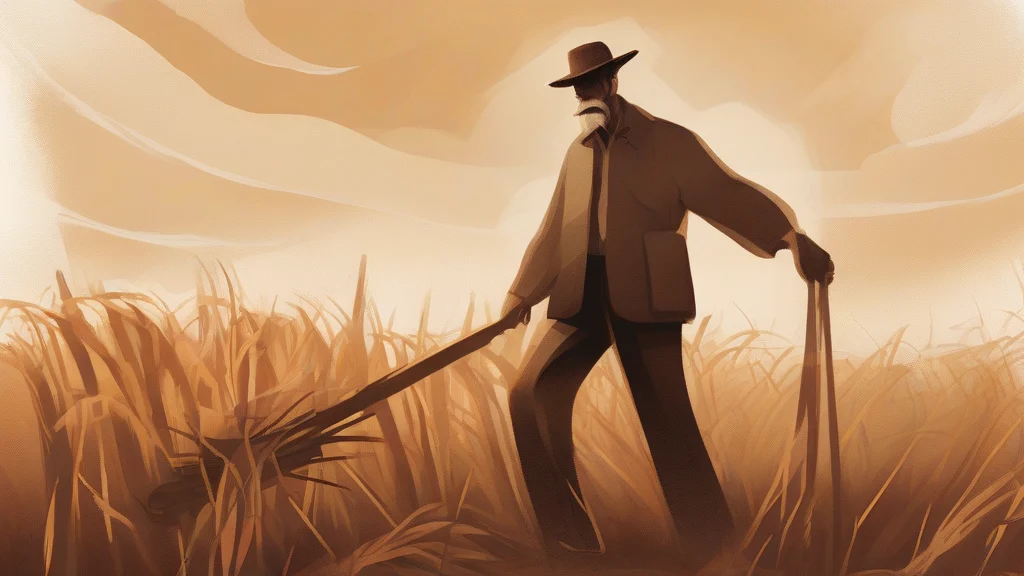
What does sickleman mean?
Sickleman is a rare historical noun for a man who cuts or harvests grain with a sickle. The term belongs to the vocabulary of manual agriculture, before mechanical mowers and combine harvesters became standard, and typically carries a rural, historical, or archaic flavor. In its ordinary sense, a sickleman was a worker whose principal task was reaping: swinging or drawing a curved blade through standing crops. The word can therefore appear in historical prose, descriptions of traditional farming, or discussions of older labor practices. Although comprehensible in standard modern English, it is uncommon in current conversation and may sound deliberately period or literary. Its plural is sicklemen. Sickleman is useful today chiefly as evidence of how English names workers through the tools they use, combining the agricultural implement sickle with the occupational suffix -man.
nounA man who cuts or reaps grain with a sickle, especially a historical agricultural laborer.
- A man who cuts or harvests grain with a sickle; a reaper or mower.
"At dusk, the sickleman moved slowly along the edge of the wheat field."
"The old sickleman began at dawn and continued until the field was completely cut."
"Historical accounts describe the sickleman as a seasonal laborer hired during harvest."
The regular plural is sicklemen, though the rarity of the word makes it uncommon in current usage.
"The sicklemen rested beneath a tree at the edge of the field."
Long before combine harvesters, the sickleman was the worker whose curved blade could bring in a day's harvest.
Reviewed by Deb Chak, Editor. AI-assisted content curated by RJS Tech Solutions LLP.
Etymology of sickleman
Sickleman is an English compound formed from sickle, an old agricultural cutting tool, and man, denoting a male worker. The first element continues Old English sicca and has cognates in other Germanic languages, including German Sich(e)l. The compound developed as occupational vocabulary in a period when grain was commonly cut by hand with sickles.
How sickleman is actually used
Rare and historical, with an archaic or literary flavor. It is more likely to occur in historical prose, traditional-farming accounts, or descriptions of earlier agricultural labor than in contemporary conversation.