
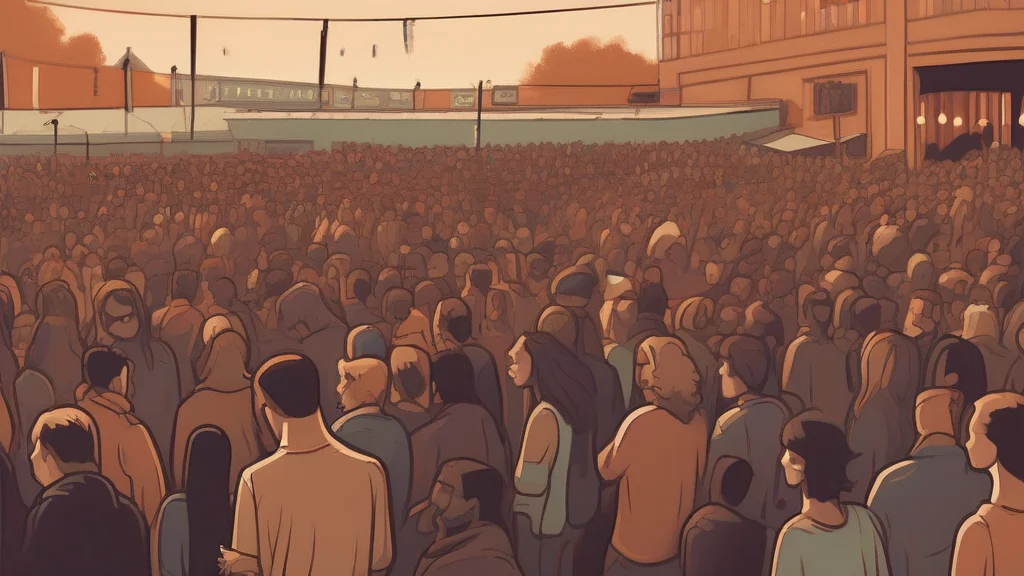
What does throng mean?
Throng is a word for a large, tightly packed group of people and, as a verb, for the movement of such a group. The noun often appears in descriptions of public places, events, and busy streets: a throng of shoppers, spectators, or commuters. The verb is especially effective when it suggests people pressing toward one another or filling a space, as in fans thronging around a performer. Its tone can range from neutral to slightly literary, but it is widely understood in both British and American English. Although crowd is the more general everyday word, throng conveys not merely the presence of people but their density and collective movement. It is therefore useful when the number and close-packed character of the group are central to the description.
A large number of people gathered closely together, especially a densely packed crowd.
"A large throng of passengers waited on the platform."
The word is common in British and American English and is often used in descriptive or literary contexts.
To gather or move together in a dense crowd, especially to fill a place with people.
"Visitors thronged the exhibition halls throughout the afternoon."
The verb often suggests movement toward a place or concentration within a limited space.
The standard plural of the noun is throngs, though throng is also frequently used in the singular to refer to a large group collectively.
"Separate throngs of fans formed outside the stadium."
From a crowded street to a packed concert, a throng is the word for a crowd so dense that movement becomes part of the scene.
Reviewed by Deb Chak, Editor. AI-assisted content curated by RJS Tech Solutions LLP.
Where does throng come from?
The word comes from Old English þrung, meaning a multitude, crowd, or swarm, and developed into its modern English forms in the early Middle English period. The verb meaning to crowd or gather in a mass developed from the noun. Related Germanic forms include Old Norse þreng and Middle Dutch throng, reflecting the word’s broader Germanic history.
Related word forms
How throng is actually used
The noun is common in British and American English and can sound somewhat formal or literary in some contexts. As a verb, throng suggests a large number of people moving together or occupying a space, often with a sense of crowding and energetic movement.