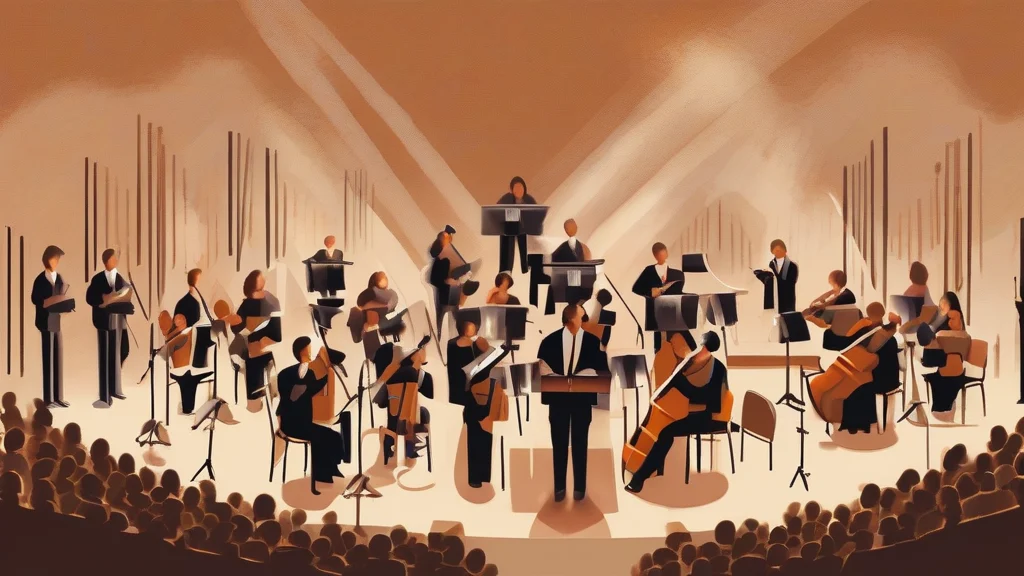
What does tutti mean?
The word 'tutti' is a musical term used to indicate that all instruments or voices in an orchestra or choir should play or sing together. It can also describe a section of a musical composition where all instruments or voices play together, often in contrast to solo or piano sections. 'Tutti' is an Italian word that translates to 'all' or 'together', and is commonly used in musical notation to create a unified sound. The term is used in various musical contexts, including classical music, jazz, and pop. Understanding 'tutti' is essential for musicians, conductors, and music enthusiasts to appreciate the complexity and beauty of musical compositions.
Used to indicate that all instruments or voices should play or sing together.
"The conductor shouted 'tutti' to signal the start of the final movement."
Often used in musical notation to contrast with 'solo' or 'piano' sections.
Describing a section of a musical composition where all instruments or voices play together.
"The musical piece featured a dramatic tutti section with crashing cymbals and soaring strings."
Reviewed by Deb Chak, Editor. AI-assisted content curated by RJS Tech Solutions LLP.
Etymology of tutti
The word 'tutti' originates from Italian, where it means 'all' or 'together'. It is derived from the word 'tutto', which is also the source of the English word 'total'. In music, 'tutti' has been used since the 17th century to indicate sections where all instruments or voices play together. The term has been adopted into various languages, including English, and is widely used in musical notation.
How tutti is actually used
In musical contexts, 'tutti' is often used to contrast with 'solo' or 'piano' sections. The term is Italian and is used in both British and US musical notation.