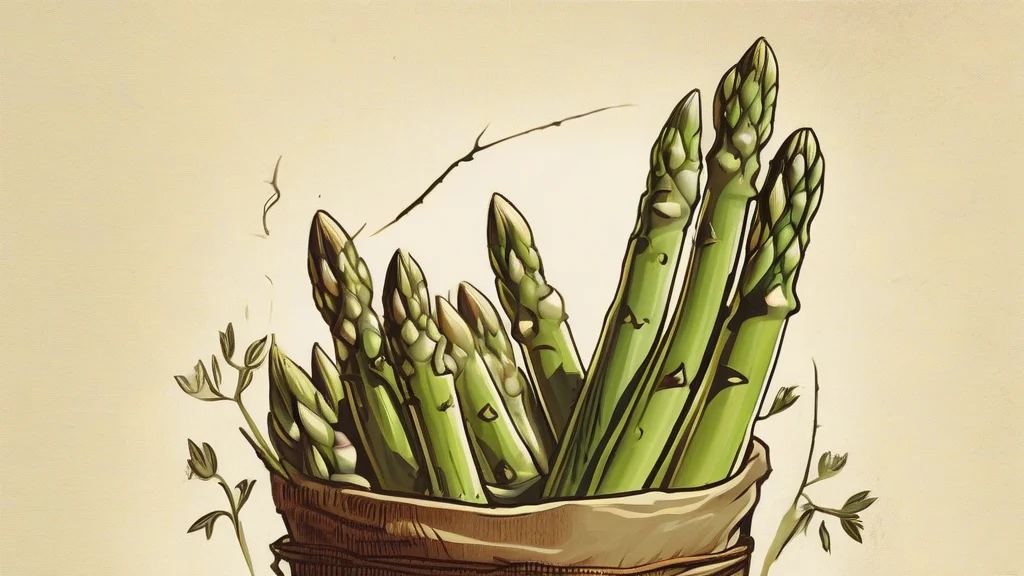
What does asparagus mean?
Asparagus is a cultivated perennial plant, Asparagus officinalis, prized above all for its tender young shoots — known as spears — which are harvested in spring and eaten as a delicately flavoured green vegetable. Native to Europe, western Asia, and North Africa, it has been grown for food since ancient times and remains a fixture of seasonal cookery, typically steamed, grilled, roasted, or blanched and served simply with butter, oil, or hollandaise. The word functions as both a mass noun, where the plural is usually also "asparagus," and occasionally as a count noun referring to individual plants. Beyond cuisine, "asparagus" names a muted yellow-green colour, and several ornamental plants unrelated to the vegetable are popularly called "asparagus fern." The word carries connotations of freshness and springtime refinement, and its long history — from Roman growers who prized it highly to modern farmers' markets — makes it one of the more storied vegetables on the plate.
A long-lived herbaceous plant (Asparagus officinalis) whose young shoots are eaten as a spring vegetable; also the shoots themselves.
"Roasted asparagus makes an excellent side dish alongside almost any main course."
Conventionally treated as having an identical singular and plural form; "asparaguses" is rare and generally avoided in careful writing.
A moderate yellow-green colour named after the appearance of the cooked vegetable.
"The cushions were upholstered in a muted asparagus fabric."
Standard usage treats "asparagus" as a mass noun whose plural is identical to its singular. The regular plural "asparaguses" exists but is uncommon and best reserved for counting individual plants.
"Three bunches of asparagus were enough for the whole dinner party."
Asparagus made an emperor build a fleet of fast boats just to fetch it: according to Pliny, Augustus kept specially swift vessels so he could get fresh spears to the table without delay.
Reviewed by Deb Chak, Editor. AI-assisted content curated by RJS Tech Solutions LLP.
Etymology of asparagus
English borrowed "asparagus" from the Latin asparagus, which itself derives from the Greek aspharagos or asparagos, the ancient name for the plant. The word entered English in the early modern period, by the sixteenth century. A later folk alteration, "sparrowgrass," arose through misdivision and was widespread in the nineteenth century before fading. The chemical terms aspartic acid and aspartame trace their names back to the same plant, from which aspartic acid was first isolated.
How asparagus is actually used
Both the singular and plural are conventionally "asparagus," though "asparaguses" appears occasionally when referring to individual plants. The word is standard register, used freely in cooking, botany, and everyday speech. In British English the archaic pronunciation/folk form "sparrowgrass" survives only as a curiosity.
Easily confused with asparagus
"Sparrowgrass" is an obsolete folk alteration of "asparagus," not a separate plant — modern usage reserves "asparagus" alone for the vegetable.