What does berlin mean?
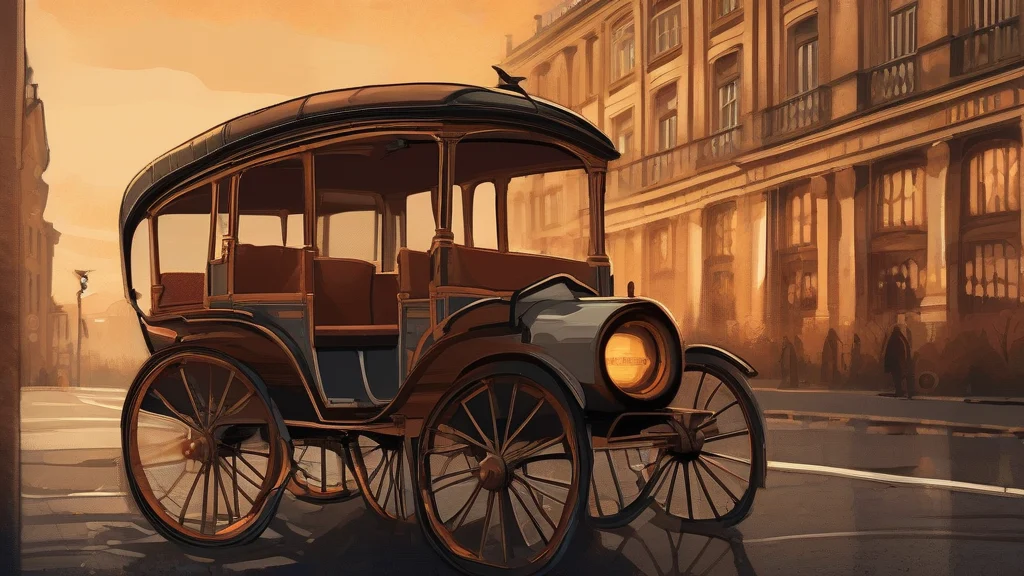
A berlin is an enclosed, four-wheeled horse-drawn carriage distinguished by its rounded body, glass windows, and a raised box at the front where the driver sat apart from the passengers. First built in or near the Prussian capital in the late seventeenth century — hence the name — it became one of the most fashionable vehicles of European aristocracy throughout the eighteenth century, prized for comfort on long journeys. By the age of railways the berlin had fallen out of use, and today the word survives mainly in historical writing, museum descriptions, and period novels. The same name was later applied to other products associated with Berlin, most notably Berlin wool, a fine soft yarn used in nineteenth-century canvas embroidery, and the decorative needlework done with it, known as Berlin work. As a common noun it is always written lowercase, distinguishing it from the German capital itself.
An enclosed four-wheeled carriage with a curved body and a driver's seat in front, originating in Berlin in the late 17th century.
"The duchess traveled to the estate in a lacquered berlin lined with velvet."
Historical; found mainly in contexts discussing eighteenth- and early-nineteenth-century transport.
Fine, soft wool yarn (Berlin wool) used in canvas embroidery, or the needlework produced with it (Berlin work); also a style of thin colored glassware associated with Berlin.
"She spent the winter months working a firescreen in vivid Berlin wool."
Standard plural, formed regularly by adding -s; used when referring to multiple carriages.
"The royal mews housed a dozen berlins polished to a mirror shine."
The word for this elegant carriage literally names the German capital — because that is where it was first built around 1670.
Reviewed by Deb Chak, Editor. AI-assisted content curated by RJS Tech Solutions LLP.
Etymology of berlin
The word derives from Berlin, the capital of Germany, where the carriage design originated around 1670. English adopted the term directly from French usage of the same name during the late seventeenth century, when such carriages became fashionable across Europe. Later compounds such as Berlin wool and Berlin work simply attach the place name to goods associated with the city or with German-made materials exported widely in the nineteenth century.
How berlin is actually used
The carriage sense is now largely historical, appearing chiefly in museums, period fiction, and writing about pre-railway transport. The craft senses (Berlin wool, Berlin work) survive mainly among embroidery enthusiasts and collectors. Always lowercase when used as a common noun.
Easily confused with berlin
Capitalized, 'Berlin' refers to the capital city of Germany, while lowercase 'berlin' is the common noun for the horse-drawn carriage or goods named after that city.