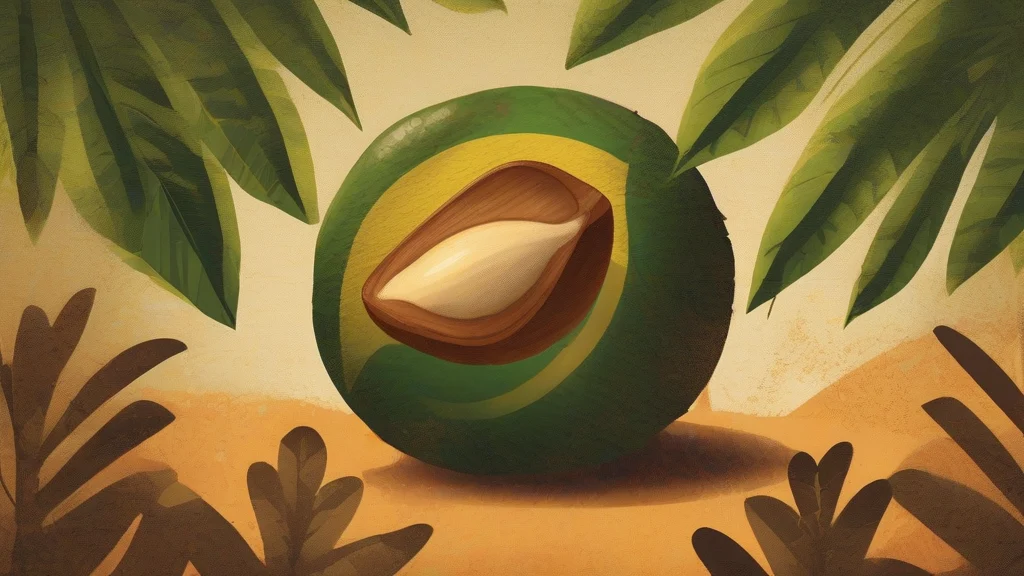
What does brazil mean?
A brazil is the large, three-sided edible seed of a towering South American rainforest tree, Bertholletia excelsa — better known to most people as the brazil nut. The seeds grow in heavy, coconut-like pods high in the canopy of the Amazon basin, and the trees are unusual in that they depend on specific orchid bees for pollination and agoutis, rodents that bury the seeds, for dispersal. In British English, 'brazils' is a familiar shorthand on ingredient lists and in baking, while American usage prefers the fuller phrase 'brazil nut'. The word carries warm, wholesome associations — festive nut bowls, brownies, and vegetarian cooking — since brazils are prized for their rich, creamy texture and their exceptionally high selenium content. The name itself traces back through Portuguese: brazilwood, the dyewood that gave the country its name, was so called because its red heartwood glowed like embers ('brasa' in Portuguese). Though botanically a seed rather than a true nut, the brazil has earned its place among them in both kitchen and language.
nounA brazil is a large, three-sided edible seed of a South American tree (Bertholletia excelsa), more commonly called a brazil nut; the singular form is used chiefly in the plural when referring to the nuts as food.
- The large, oily, three-sided edible seed of the South American tree Bertholletia excelsa, known in full as the brazil nut.
- The tall rainforest tree (Bertholletia excelsa) that bears these seeds.
"She cracked a handful of brazils and scattered them over the salad."
"Fold some chopped brazils into the cookie dough for extra crunch."
"Brazil trees can live for five hundred years and grow taller than any other tree in the Amazon."
The plural is the usual form when referring to the nuts as food, particularly in British English; American English typically says 'brazil nuts'.
"A bowl of brazils and walnuts sat on the sideboard at Christmas."
The country got its name from the nut's tree, not the other way around — Portuguese explorers named Brazil after the brazilwood ('pau-brasil', 'ember-like wood') they harvested there.
Reviewed by Deb Chak, Editor. AI-assisted content curated by RJS Tech Solutions LLP.
Etymology of brazil
The word 'brazil' entered English in the late Middle Ages via medieval Latin 'brasillum' and Old French, originally referring to a red dye-wood valued in European trade long before the discovery of the Americas. When Portuguese colonizers encountered a similar dye-producing tree along the coast of South America, they called it 'pau-brasil' — literally 'ember wood', from Portuguese 'brasa', meaning glowing ember — and the land itself eventually took the name Brazil. The edible seed of a different South American tree then borrowed the same name, becoming the 'brazil nut'. Related words sharing the 'ember' root include 'brazier', the vessel for holding burning coals.
How brazil is actually used
In everyday usage the plural 'brazils' is common in British English, especially in food contexts, while American English almost always uses the full term 'brazil nut'. Lowercase 'brazil' should not be confused with the proper noun 'Brazil'.
Easily confused with brazil
Lowercase 'brazil' refers to the edible nut, while capitalized 'Brazil' is the South American country whose name shares the same Portuguese origin.