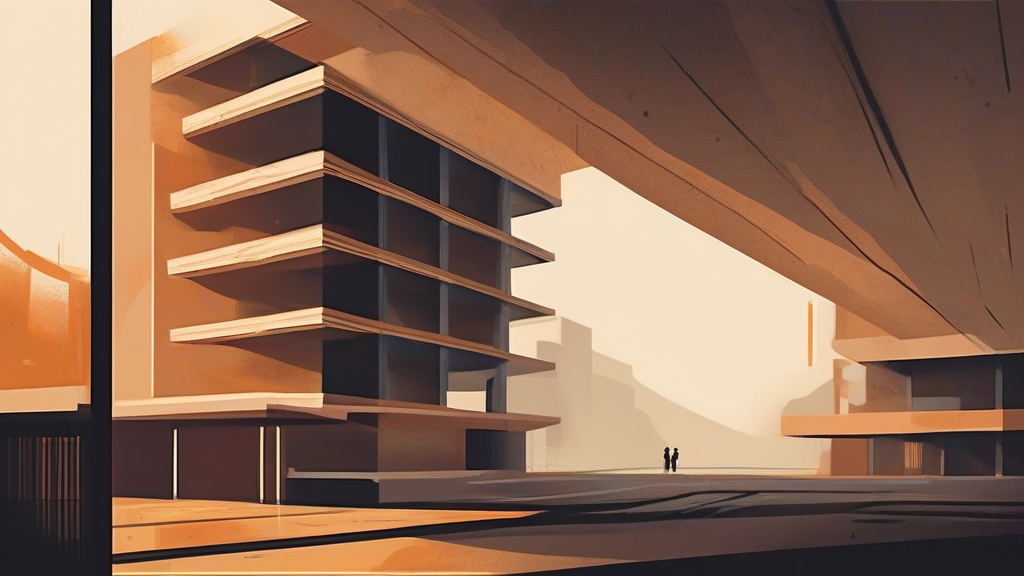
What does brutalist mean?
"Brutalist" describes the work of, or characteristic of, Brutalism — an architectural movement that flourished from the 1950s through the 1970s and is known for massive, sculptural forms, repetitive geometric shapes, and the unmasked use of raw concrete. As a noun, a brutalist is an architect who works in this style or a supporter of its principles; as an adjective, the word applies to buildings and also, by extension, to anything austere, heavy, and stripped of decoration, from furniture to web pages. The name derives not from brutality but from the French phrase béton brut, meaning raw concrete, a material central to the movement's identity. Long criticized as cold and oppressive, Brutalist structures have enjoyed a significant revival of appreciation in recent decades, with many now listed as protected landmarks. The word therefore carries shifting connotations: severity and monumentality to admirers, grimness and alienation to detractors.
Relating to or characteristic of Brutalism, the architectural style featuring raw concrete, massive forms, and exposed structure; by extension, severely plain or utilitarian.
"The museum's brutalist wing divides opinion among visitors."
Often capitalized when referring strictly to the historical movement.
An architect, designer, or advocate associated with Brutalism.
"As a young brutalist, she championed honest materials over decorative finishes."
Used only for the noun sense referring to people who practice or advocate Brutalism.
"The exhibition gathered works by leading brutalists of the postwar era."
The name has nothing to do with cruelty — it comes from the French "béton brut," meaning raw concrete.
Reviewed by Deb Chak, Editor. AI-assisted content curated by RJS Tech Solutions LLP.
Etymology of brutalist
"Brutalist" derives from the French term béton brut, meaning "raw concrete," which Swiss-French architect Le Corbusier used to describe his unfinished concrete surfaces. The English term took hold in the mid-20th century when British architects Alison and Peter Smithson and critic Reyner Banham popularized "New Brutalism" in the early 1950s. The word thus shares its root with "brutal" and cognates such as "brute" and "brutality," all tracing back to the Latin brutus, meaning heavy, dull, or irrational — though the architectural sense emphasizes the rawness of the material rather than any quality of cruelty.
Related word forms
How brutalist is actually used
The term is most strongly associated with architecture, where it is often capitalized as part of "Brutalism." Applied outside buildings — to web design, furniture, or prose — it usually signals deliberate austerity rather than ugliness, though for many people the word still carries connotations of harshness and coldness.
Easily confused with brutalist
"Brutal" means savage or cruel in a general sense, while "brutalist" specifically refers to the architectural style of Brutalism or its adherents.