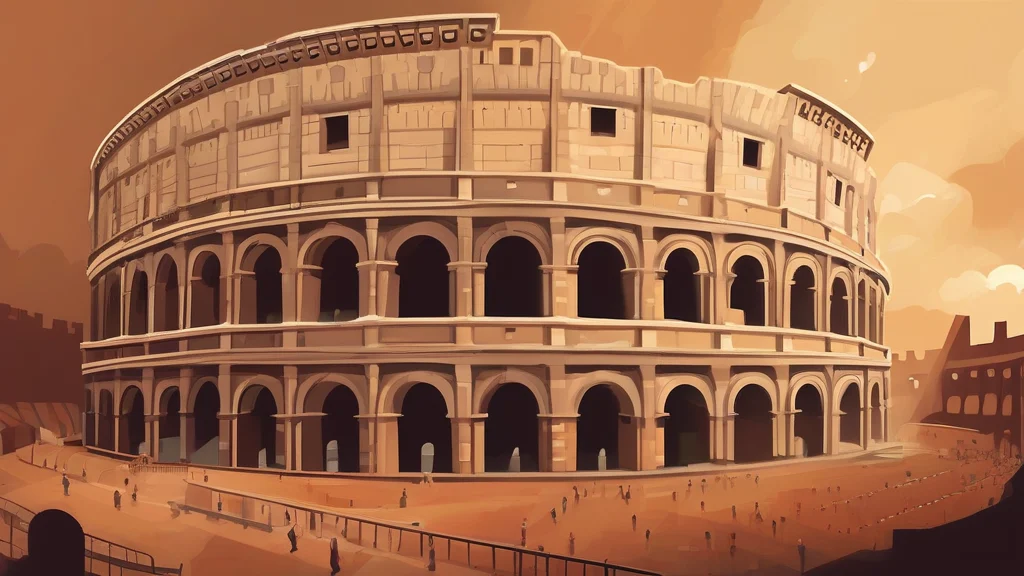
What does colosseum mean?
A colosseum is a vast amphitheatre or arena designed to hold crowds for public spectacles, from gladiatorial combat in antiquity to concerts and sporting events today. The word derives its capital-letter fame from the Colosseum of Rome, the enormous Flavian Amphitheatre completed in the first century AD, which remains one of the most visited monuments in the world. Used in lower case, the term carries a connotation of grandeur and spectacle: writers often call a packed stadium or a dramatic contest venue a 'modern-day colosseum' to evoke drama, scale, and crowd energy. The related spelling 'coliseum' is common, particularly in names of specific theatres and arenas. The word traces back through Latin and ultimately to Greek, sharing a root with 'colossal', which explains why both words suggest immense size.
nounA large amphitheatre or stadium, especially one built for public spectacles; the term most famously refers to the ancient Roman Flavian Amphitheatre in Rome.
- The great Flavian amphitheatre in Rome, completed around AD 80, used for gladiatorial contests and public spectacles.
- Any large building or venue resembling an amphitheatre, especially one used for sports events or large-scale entertainment.
"The city's newest arena was hailed as a modern colosseum for live music."
"Tourists queued for hours to see the Colosseum illuminated at dusk."
"The boxing match drew sixty thousand fans to what the press called a twenty-first-century colosseum."
The regular plural 'colosseums' is standard; the Latinate plural 'colossea' is rare and chiefly found in scholarly writing.
"Ancient colosseums can still be seen scattered across the former Roman Empire."
Rome's Colosseum got its name not from its size, but from a giant bronze statue of Nero — the 'Colossus' — that stood beside it.
Reviewed by Deb Chak, Editor. AI-assisted content curated by RJS Tech Solutions LLP.
Etymology of colosseum
The word comes from Latin, via the medieval Latin 'colosseum' applied to the Flavian Amphitheatre in Rome. The name was inspired by the nearby colossal bronze statue of the emperor Nero known as the Colossus of Nero, itself derived from Greek 'kolossos', meaning a giant statue. This same root gives English the word 'colossal'. The variant spelling 'coliseum' arose by association with Latin nouns ending in '-eum' denoting places.
How colosseum is actually used
When capitalized and preceded by 'the', the word refers specifically to the ancient Roman amphitheatre in Rome; lowercase, it functions generically for any comparable large arena. The spelling 'coliseum' is an accepted variant.
Easily confused with colosseum
'Coliseum' is simply a variant spelling of the same word, but it is more often used as a proper name for specific venues such as London's Coliseum Theatre.