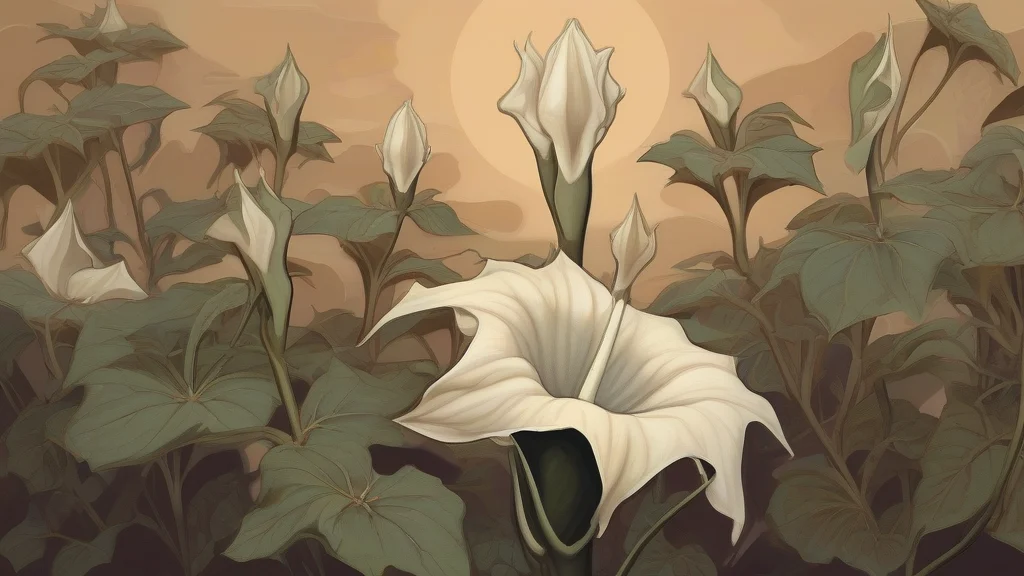
What does datura mean?
Datura is a genus of flowering plants in the nightshade family, Solanaceae, comprising roughly a dozen species native to warm temperate and tropical regions of the Americas and elsewhere. Known commonly as thornapples or jimsonweeds, these fast-growing annuals and shrubs bear large, funnel-shaped white or violet flowers that typically open in the evening, along with distinctive spiny seed capsules. The word functions as a countable noun: botanists may speak of several species of datura, while gardeners might refer to planting a datura by a doorway for its evening fragrance. Despite its striking beauty, every part of the plant — seeds, leaves, flowers, and roots — contains tropane alkaloids such as scopolamine and atropine, making it dangerously poisonous if ingested. Historically, various cultures have used datura in ritual, medicine, and even deliberate poisoning, so the name frequently appears in contexts involving herbalism, toxicology, and folklore. The plural form is daturas.
nounA genus of strongly scented, poisonous flowering plants of the nightshade family (Solanaceae), native to warm regions and commonly known as thornapples or jimsonweeds; also, an individual plant of this genus.
- A genus of poisonous plants in the nightshade family, bearing trumpet-shaped white or purple flowers and spiny seed capsules (thornapple, jimsonweed).
- An individual plant belonging to this genus.
"The abandoned lot was overrun with datura, its white trumpet-shaped flowers opening only at dusk."
"Gardeners are warned to handle datura with gloves, since all parts of the plant contain dangerous tropane alkaloids."
"In traditional medicine, small doses of datura were once used as a painkiller despite its well-known toxicity."
The standard plural follows regular English patterns. When referring to multiple species rather than individual plants, botanical convention favors 'species of Datura' with the capitalized, italicized genus name.
"Several daturas self-seeded throughout the garden after one summer's planting."
Every part of the datura plant — roots, leaves, flowers, seeds — is toxic enough to cause hallucinations, delirium, and death, earning it folk names like devil's snare and hell's bells.
Reviewed by Deb Chak, Editor. AI-assisted content curated by RJS Tech Solutions LLP.
Etymology of datura
The word datura entered scientific Latin as the botanical genus name, ultimately deriving from the Sanskrit word dhatūra, the ancient Indian name for the thornapple plant. It passed through Hindi into European botanical usage, where it was formalized by early taxonomists such as Linnaeus in the eighteenth century, though references to the plant under similar names appear in European herbals by the sixteenth century. The term thus reflects the plant's long history of use in Indian medicine and ritual before its adoption into Western botanical nomenclature.
How datura is actually used
A formal or technical term used chiefly in botany, horticulture, gardening literature, and accounts of plant toxicity. In everyday speech, the common names jimsonweed or thornapple are more frequent for the weedy species, while datura often appears when discussing the genus broadly or its ornamental forms. The word carries connotations of danger and toxicity because of the plant's potent poisons.
Easily confused with datura
A datum is a single piece of information, whereas datura is a genus of poisonous flowering plants.
Brugmansia (angel's trumpets) is a closely related genus once classified within Datura, distinguished by its hanging, tree-like trumpet flowers rather than upright ones on herbaceous plants.