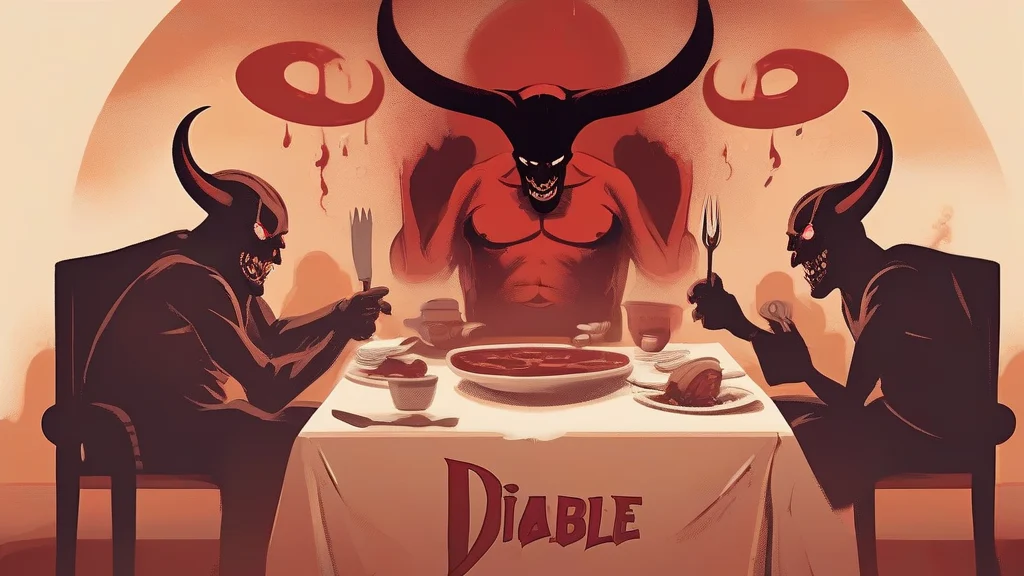
What does diable mean?
Diable is the French word for the devil, taken into English as a relatively rare noun that survives mainly in set phrases rather than free use. Its most familiar appearances are culinary: a sauce diable is a sharp, spicy sauce traditionally served with grilled meats or devilled dishes, while 'à la diable' describes food prepared with fiery seasoning — the heat of the spice suggesting the fires of hell. Beyond the kitchen, diable may appear in writing that borrows French colour, whether for archaic effect, mild blasphemy, or literary flavour, much as an English writer might drop in 'mon dieu'. The word derives, like 'devil' itself, from Latin diabolus, ultimately from Greek diabolos meaning 'slanderer' or 'accuser'. For everyday purposes English writers need only 'devil'; diable is valued precisely for its foreignness, lending menus and period fiction a touch of continental menace.
The devil; a demon or evil spirit, especially when named using the French word for stylistic or humorous effect.
"The old inn sign showed a grinning diable with a pitchfork."
Chiefly literary, archaic, or facetious in modern English.
In cookery, designating a dish served in a hotly spiced, piquant style, as in sauce diable or eggs à la diable.
"She dressed the broiled chicken with a classic sauce diable."
Usually appears attributively within French-derived culinary phrases rather than standing alone.
Very rarely needed; the plural follows regular English formation and would occur mainly in translations or discussions of French text.
"Medieval mystery plays crowded their stages with snarling diables."
English kept the French word for the devil alive mainly on the dinner table — 'sauce diable' literally means 'devil's sauce', so named for its fiery spicing.
Reviewed by Deb Chak, Editor. AI-assisted content curated by RJS Tech Solutions LLP.
Etymology of diable
Diable comes from Old French diable, from Latin diabolus, itself borrowed from Greek diabolos, literally 'slanderer' or 'accuser', from diaballein, 'to throw across' or 'to slander'. Latin diabolus also passed into Old English as dēofol, giving modern English 'devil', making the two words true doublets of one another. English acquired diable through contact with French, retaining it chiefly in fixed expressions, especially those of cooking such as sauce diable and à la diable.
How diable is actually used
Rare as an independent word in modern English; it survives almost exclusively in fixed French borrowings, especially culinary ones. When used at all it carries a deliberately French flavour, often jocular or archaic in tone. In French itself it is also used in mild oaths (for example 'que diable!'), but such interjectional use has not become established in English.
Easily confused with diable
'Diable' is simply the French word for the devil, borrowed into English only in set phrases, whereas 'devil' is the ordinary English word used freely in all contexts.