What does dryad mean?
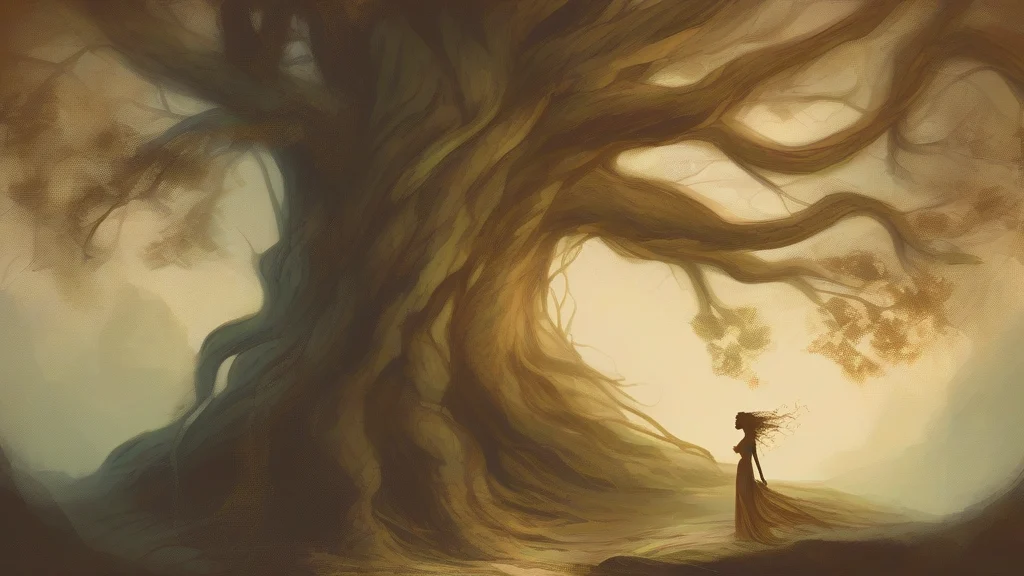
A dryad is a tree nymph from Greek mythology — a female nature spirit believed to inhabit, watch over, or be bound to a particular tree, most famously the oak. In classical belief, dryads were shy beings who lived deep within forests, and some traditions held that their fates were tied to their trees: to fell the tree was to destroy its guardian spirit. The word entered English in the late fourteenth century via Latin and French, ultimately deriving from the Greek 'drys,' meaning oak tree. Though rooted in ancient religion, dryad survives vividly today as a literary and poetic term, appearing frequently in poetry, Romantic and Victorian prose, and modern fantasy literature, where it often denotes any graceful woodland spirit. It evokes enchantment, wildness, and the sacredness of trees, making it a favourite of writers seeking an evocative image of nature personified.
nounA dryad is a tree nymph or tree spirit in Greek mythology, specifically a nymph inhabiting or associated with a particular tree. By extension, the word is used in literature and poetry for any wood nymph or forest spirit.
- (Greek mythology) A nymph or spirit inhabiting or associated with a tree, especially an oak.
- (By extension, literary) Any wood nymph or forest sprite.
"The old oak was said to shelter a dryad, and no villager would dare cut its branches."
"Legend held that a dryad dwelled within the ancient oak at the heart of the grove."
"In her poem, the moonlight through the birches conjured images of dryads dancing between the trunks."
Standard English plural; occasionally the learned plural 'dryades' is seen in scholarly or poetic contexts.
"According to the myth, dryads fled weeping whenever mortals raised an axe against the ancient trees."
In Greek belief, cutting down a tree could kill the spirit living inside it — which made ancient lumberjacking a genuinely risky business.
Reviewed by Deb Chak, Editor. AI-assisted content curated by RJS Tech Solutions LLP.
Etymology of dryad
Dryad comes from the Greek 'dryas' (plural 'dryades'), meaning a wood nymph, derived from 'drys,' meaning oak tree or tree. The word passed into Latin as 'dryas' and then into Middle English in the late fourteenth century through Old French and Latin sources. A closely related term, hamadryad, refers specifically to a nymph whose life is inseparable from that of her tree.
Related word forms
How dryad is actually used
Dryad is a literary and somewhat archaic word; it appears mainly in poetry, fantasy fiction, mythology discussions, and elevated prose rather than everyday speech. It carries connotations of classical antiquity, woodland enchantment, and the personification of nature.
Easily confused with dryad
A hamadryad is a specific kind of dryad whose life is bound to the tree she inhabits, dying when the tree dies; 'dryad' is the broader term for any tree nymph.
A druid was a member of the priestly class among the ancient Celts, whereas a dryad is a mythological Greek tree spirit.