What does aardvark mean?
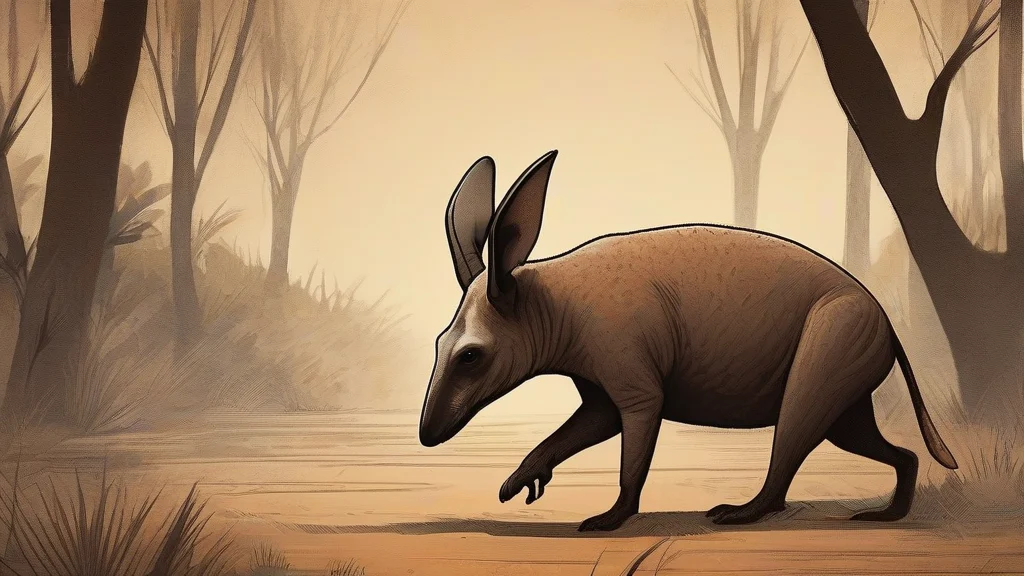
An aardvark is a nocturnal mammal native to sub-Saharan Africa, known scientifically as Orycteropus afer. It has a stocky, arched body, a long pig-like snout, prominent ears, powerful claws for digging, and a sticky tongue that can extend to gather its primary food: ants and termites. Aardvarks live alone in burrows, which they dig with remarkable speed, and abandoned burrows often provide shelter for other animals. The name comes from Afrikaans and literally means 'earth pig', reflecting both its burrowing habits and its pig-like appearance. Despite superficial resemblance to South American anteaters, the aardvark is unrelated to them and is the only living member of its order, Tubulidentata. In usage, the word appears almost exclusively in literal contexts — nature writing, zoology, and children's books — rather than as metaphor or idiom. Its distinctive spelling and sound have also made it famous as the first entry in many English dictionaries.
nounA nocturnal African mammal (Orycteropus afer) with a long snout, large ears, and a sticky tongue, which feeds chiefly on termites and ants and lives in burrows.
- The nocturnal African mammal Orycteropus afer, which feeds on ants and termites and lives in excavated burrows.
"The aardvark tore open the termite mound under cover of darkness and fed for hours with its sticky tongue."
"Guides on the night drive were thrilled when an aardvark emerged from its burrow near the waterhole."
"In many African folk tales, the aardvark is admired for its diligent search for food."
Standard regular plural; aardvarks are solitary, so the plural most often appears in ecological or descriptive writing about populations.
"Aardvarks are widespread across sub-Saharan Africa wherever termites are plentiful."
The aardvark isn't related to any other living animal — it's the sole survivor of an entire order of mammals, making it one of evolution's great lone rangers.
Reviewed by Deb Chak, Editor. AI-assisted content curated by RJS Tech Solutions LLP.
Etymology of aardvark
The word aardvark entered English from Afrikaans in the late eighteenth or early nineteenth century, borrowed directly from the Dutch-derived speech of settlers in southern Africa. It combines 'aarde', meaning earth, and 'vark', meaning pig, so the name literally translates as 'earth pig' — a reference to the animal's burrowing lifestyle and pig-like snout. A close relative in formation is the aardwolf, another Afrikaans coinage meaning 'earth wolf', applied to a termite-eating hyena species. The word retains its original spelling unchanged in both British and American English.
How aardvark is actually used
Aardvark is a fairly formal or scientific term, used mainly in zoological, educational, and wildlife contexts rather than everyday conversation. It carries no figurative or idiomatic use in standard English. The word is pronounced with stress on the first syllable, though British speakers often use a long 'ah' vowel while American speakers typically use a rounded 'ar'.
Easily confused with aardvark
An anteater is a superficially similar mammal of Central and South America that also eats ants and termites, whereas the aardvark is an unrelated African animal in its own order, Tubulidentata.