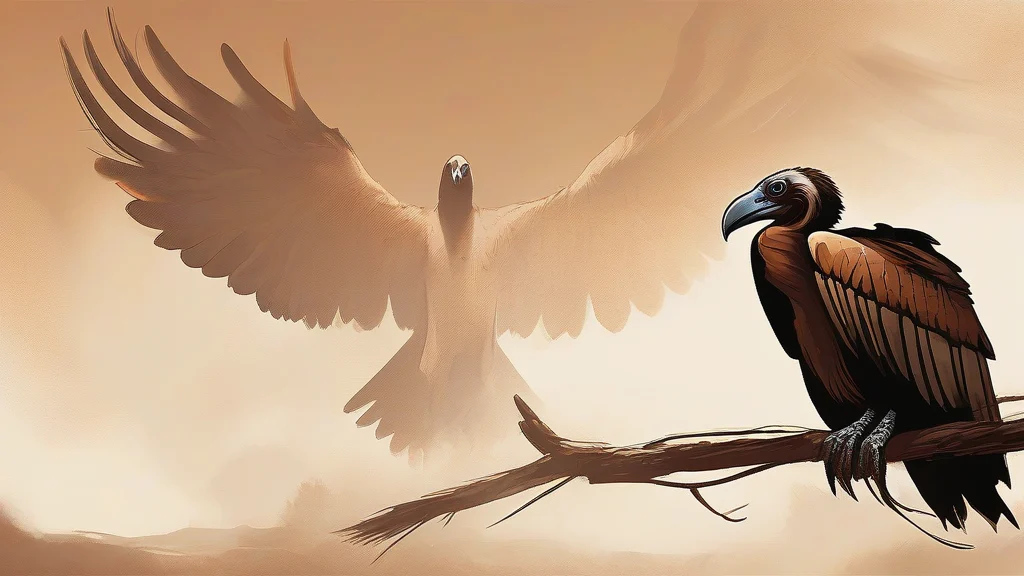
What does aasvogel mean?
An aasvogel is a vulture or other bird that feeds on carrion, the word being used primarily in South African English. It entered English through Afrikaans and derives ultimately from Dutch, combining 'aas' (carrion) with 'vogel' (bird), so its literal sense is 'carrion-bird'. In everyday South African usage it refers simply to vultures, the large scavenging raptors that circle over carcasses on the veld and perform an essential ecological role by disposing of dead animals. The plural is 'aasvogels'. Outside southern Africa the word is rare, and English speakers would normally say 'vulture'; encountering 'aasvogel' usually signals South African writing or speech. Like 'vulture', it can occasionally be used figuratively to describe a person who profits from others' misfortune, but its core use is straightforwardly zoological, making it a distinctive regional alternative within the vocabulary of birds and scavenging.
nounA vulture or other carrion-eating bird; the term is used chiefly in South African English for vultures.
- A vulture or any bird that feeds on carrion, especially as referred to in South African usage.
"The aasvogels circled high above the carcass on the open plain."
"From the ridge we watched an aasvogel descend slowly toward the remains."
"Farmers once regarded the aasvogel as a nuisance, though it plays a vital role in clearing carcasses."
Regular plural formation; used when referring to multiple carrion birds.
"Dozens of aasvogels gathered at the waterhole's edge."
In Afrikaans, 'aas' means carrion and 'vogel' means bird — so an aasvogel is literally a 'carrion-bird', nature's clean-up crew of the African sky.
Reviewed by Deb Chak, Editor. AI-assisted content curated by RJS Tech Solutions LLP.
Etymology of aasvogel
The word comes from Afrikaans 'aasvogel', itself inherited from Dutch, where 'aas' means carrion or bait and 'vogel' means bird. It was adopted into South African English during the colonial period alongside many other Afrikaans terms for local flora, fauna, and landscape. Its components are common Germanic words, with 'vogel' being the regular Dutch cognate of English 'fowl'.
How aasvogel is actually used
The word is a borrowing from Afrikaans (ultimately from Dutch) and is used almost exclusively in South African English contexts; elsewhere 'vulture' is the normal term. It carries no strong connotation beyond its literal meaning, though it can appear in figurative references to someone who preys on the misfortune of others.