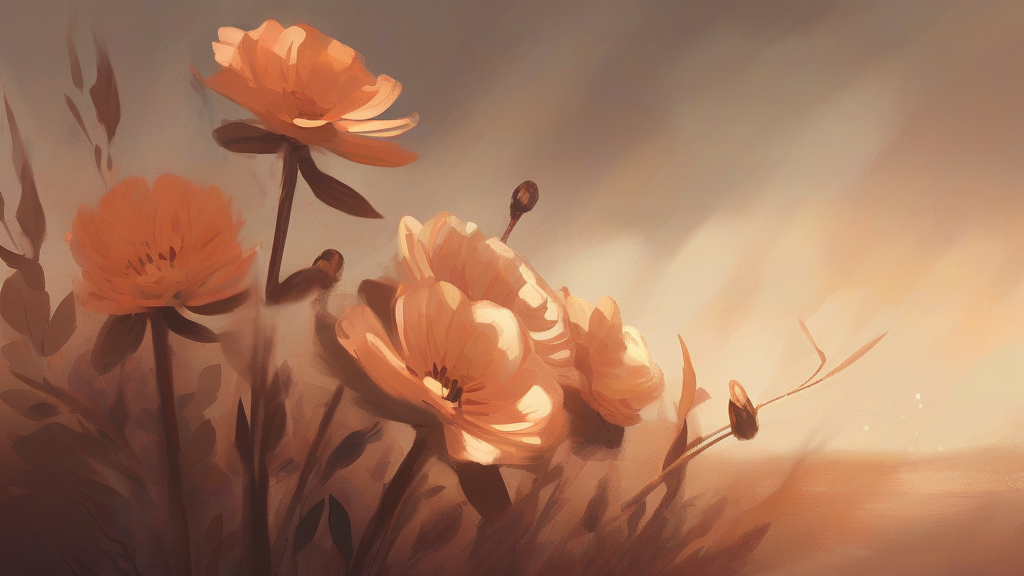
What does abloom mean?
Abloom is an adjective meaning 'in flower' or 'covered with blossoms', applied to plants, trees, shrubs, gardens, and landscapes at the height of their flowering season. It is formed from the prefix 'a-', indicating a state or condition, joined to 'bloom', and belongs to a small family of descriptive words with the same pattern, such as ablaze and aglow. Abloom is predominantly used after a verb — one says that orchards are abloom or that a meadow has come abloom — rather than directly before a noun, and it often appears with the preposition 'with', as in 'abloom with cherry blossoms'. The word has a distinctly literary, poetic register: writers reach for it when they want to evoke abundance, freshness, and the brief, vivid beauty of spring. By extension it can occasionally describe something figuratively flourishing or radiant. Though uncommon in casual speech, abloom is precise and evocative, making it a valuable addition to any vocabulary concerned with nature and description.
In flower; blooming; covered with blossoms.
"The hillside was abloom with wildflowers by mid-May."
Almost always used predicatively rather than before a noun, and commonly followed by 'with' to specify what is flowering.
Into or as if into bloom; so as to be flowering.
"The gardens burst abloom overnight after the rain."
This adverbial use is considerably rarer than the adjectival use.
Abloom is built like a tiny poem: just the prefix 'a-' plus 'bloom' — two syllables that turn an ordinary garden into a scene of sudden, total flowering.
Reviewed by Deb Chak, Editor. AI-assisted content curated by RJS Tech Solutions LLP.
Etymology of abloom
Abloom was formed in English from the prefix 'a-', derived from Old English 'an' meaning 'on' or 'in', combined with 'bloom'. The word 'bloom' itself entered Middle English from Old Norse 'blóm', meaning flower, reflecting the strong Scandinavian influence on northern English dialects. Abloom thus shares its ultimate Germanic root with related words such as 'blossom' and the verb 'blow' in its older sense of 'to flower'. The compound follows a productive English pattern of 'a-' plus noun that yields state-of-being adjectives like ablaze, afire, and aglow.
How abloom is actually used
Abloom is a literary or poetic word rather than everyday vocabulary; it functions predicatively (the garden was abloom) far more often than attributively, and it frequently takes the complement 'with' to name what is flowering. It carries a fresh, positive connotation of abundance and seasonal beauty.
Easily confused with abloom
Ablaze means burning or brightly lit, while abloom means covered in blossoms or flowers.