What does abscission mean?
Abscission is the process by which an organism naturally detaches one of its parts, most famously when deciduous trees shed their leaves each autumn. In botany, this occurs at a precisely engineered region of cells known as the abscission zone, where hormonal signals cause the tissue to weaken so that wind or gravity can release the leaf, flower, or fruit cleanly without harming the plant. The word also has broader and older uses, referring to any act of cutting off or removing a part, including surgical removal of tissue. Abscission is a formal, technical term encountered mainly in plant science, horticulture, and medicine, and it is rarely used in everyday conversation. It is nonetheless a valuable word for anyone interested in how living things regulate themselves: far from being passive decay, abscission is an active, adaptive strategy that conserves water and energy, disperses seeds, and allows organisms to discard what no longer serves them.
nounThe natural detachment of a part of an organism, especially the shedding of leaves, flowers, or fruit by a plant. More generally, the act of cutting off or removing something.
- In botany: the natural process by which a plant sheds leaves, flowers, fruit, or other parts, typically at a specialized abscission zone.
- In medicine and general use: the act of cutting off or removing a part, such as the surgical removal of tissue.
"As autumn deepened, abscission of the maple's leaves left the branches bare against the sky."
"Cooler temperatures and shorter days trigger leaf abscission in deciduous trees."
"The surgeon performed an abscission of the damaged tissue to prevent further infection."
Usually treated as a mass noun describing a process; the plural appears only when counting distinct instances, e.g. across different plants or specimens.
"Researchers recorded multiple abscissions across the orchard after the first frost."
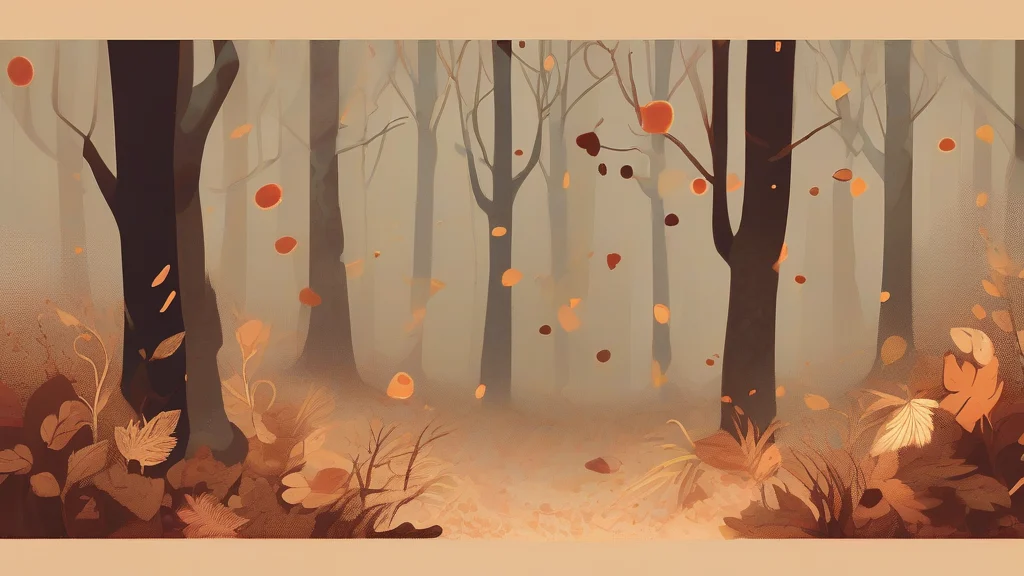
Every autumn, trees don't just 'drop' their leaves — they actively amputate them at a pre-built cellular weak point called the abscission zone.
Reviewed by Deb Chak, Editor. AI-assisted content curated by RJS Tech Solutions LLP.
Etymology of abscission
Abscission derives from the Latin verb abscindere, meaning 'to cut off' or 'to tear away', formed from ab- ('away from') plus scindere ('to cut or split'). It entered English in the early seventeenth century, initially carrying the general sense of removal or severance before becoming established as a precise botanical term. It shares its root with words such as decide, concise, and scissors, all of which trace back to the same Indo-European root *skei-, meaning 'to cut or split'.
Related word forms
How abscission is actually used
Abscission is a technical term used chiefly in botany and plant physiology; outside scientific contexts it is rare and formal. It carries no emotional connotation — it describes a neutral biological or surgical process rather than a loss with negative overtones.
Easily confused with abscission
Though they rhyme, 'decision' means a choice reached after deliberation, while 'abscission' refers to the biological shedding or surgical cutting away of a body part.