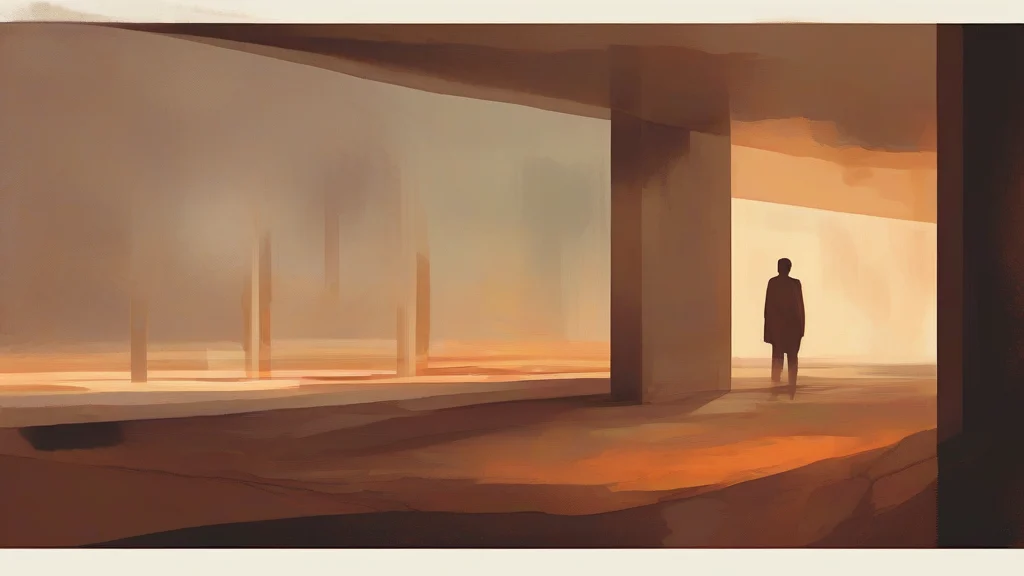
What does abstracted mean?
Abstracted describes someone whose mind has drifted inward, leaving them seemingly unaware of what is happening around them. An abstracted person may stare into space, answer questions vaguely, or fail to notice events unfolding nearby — the word suggests deep thought rather than laziness or rudeness, and it often carries a gentle, even sympathetic connotation. It derives from the Latin abstrahere, meaning to draw away, so an abstracted mind is literally one that has been pulled away from present surroundings. The word can also describe things considered apart from their concrete circumstances, as when a principle is discussed abstracted from real-world examples. In modern usage it appears most often in literary and descriptive writing, where phrases such as 'an abstracted air' or 'an abstracted manner' evoke a character lost in reverie. Related adverbs and nouns include abstractedly and abstractedness.
Preoccupied or lost in thought, with little awareness of one's surroundings.
"The professor gave an abstracted nod, still turning the problem over in his mind."
Often used attributively before nouns such as 'air', 'manner', 'expression', or 'voice'.
Considered apart from concrete circumstances or specific instances; generalized or removed from context.
"Justice, abstracted from any legal system, remains a difficult ideal to define."
This sense occurs chiefly in philosophical, academic, or theoretical writing.
When you're abstracted, your mind has literally been 'dragged away' — the same Latin root that gives us tractor and traction is at work pulling your attention off somewhere else.
Reviewed by Deb Chak, Editor. AI-assisted content curated by RJS Tech Solutions LLP.
Etymology of abstracted
Abstracted comes from the Latin abstrahere, formed from abs- ('away') plus trahere ('to draw or pull'), giving the literal sense of 'drawn away'. The word entered English via the verb abstract, borrowed through Latin past participle forms, with the adjective sense of mentally withdrawn developing by the early 17th century. It shares this trahere root with a wide family of English words including attract, contract, distract, extract, protract, retract, subtract, and tract.
Related word forms
How abstracted is actually used
Primarily a literary or formal register when describing a person's mental state; in everyday speech, 'preoccupied' or 'distracted' are more common. The second sense, describing something removed from context, appears mostly in academic or philosophical writing.
Easily confused with abstracted
Distracted means having one's attention pulled away by external things, while abstracted means being withdrawn into one's own thoughts.
Abstraction is a noun referring to the act or idea of drawing something away or generalizing it, whereas abstracted is an adjective describing a person's absent-minded state.