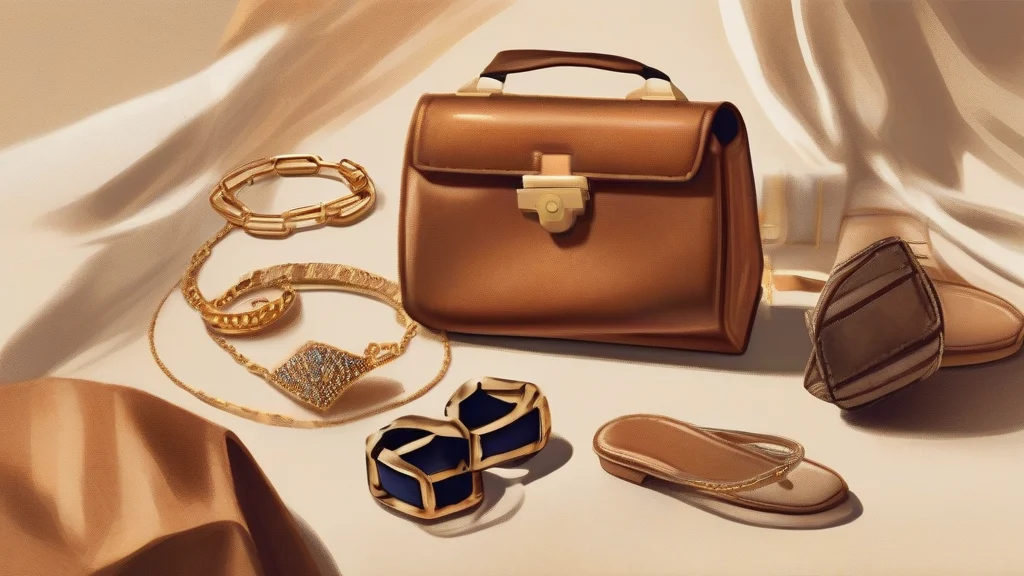
What does accessorizing mean?
Accessorizing refers to the practice of adding accessories—items such as jewelry, scarves, belts, hats, handbags, or watches—to an outfit in order to complete, personalize, or elevate its overall look. Derived from the verb 'accessorize,' which emerged in twentieth-century fashion vocabulary, the word treats accessories not as afterthoughts but as essential elements of personal style. A skilled dresser understands that accessorizing can transform even the simplest garment: a plain black dress becomes striking with the right necklace, while a basic blouse gains character from a patterned scarf. The term also extends beyond clothing, describing the act of furnishing rooms, cars, or devices with complementary items that add both function and flair. Widely used in fashion media, styling guides, and everyday conversation, accessorizing carries connotations of taste, creativity, and attention to detail, making it a useful word for anyone interested in how small additions create a polished whole.
verb (present participle/gerund)The act of adding accessories—such as jewelry, scarves, belts, or bags—to an outfit or object to complete or enhance its appearance.
- Adding decorative items such as jewelry, belts, scarves, or handbags to clothing to complete or enhance an outfit.
- More broadly, furnishing or equipping something (such as a room, car, or gadget) with supplementary items that add function or style.
"She spent the morning accessorizing her little black dress with a statement necklace and vintage earrings."
"He has a real talent for accessorizing—a simple watch and leather bracelet transform his plainest shirts."
"The interior designer focused on accessorizing the living room with cushions, throws, and ceramic vases."
The word 'accessorize' didn't exist until the 20th century—fashion finally got a verb for what style icons had been doing all along.
Reviewed by Deb Chak, Editor. AI-assisted content curated by RJS Tech Solutions LLP.
Etymology of accessorizing
Accessorizing derives from 'accessorize,' a twentieth-century coinage formed by adding the suffix '-ize' to 'accessory.' The noun 'accessory' traces back through French to the Latin 'accessorius,' meaning additional or supplementary, itself derived from 'accedere,' to approach or be added to. The verb gained currency as fashion culture grew in the mid-1900s, giving speakers a dedicated term for the act of completing an outfit with extras. Its Latin root also underlies related words such as 'accessible,' 'accession,' and 'accede,' all sharing the sense of drawing near or being added.
Related word forms
How accessorizing is actually used
Common chiefly in fashion journalism, styling advice, and everyday conversation about dress; slightly informal in register but fully standard. The verb 'accessorize' and its participle are largely confined to English-speaking fashion contexts and have no exact equivalent in many other languages.
Easily confused with accessorizing
Assessing means evaluating or estimating the value or quality of something, while accessorizing means adding decorative items to enhance an outfit or object.