
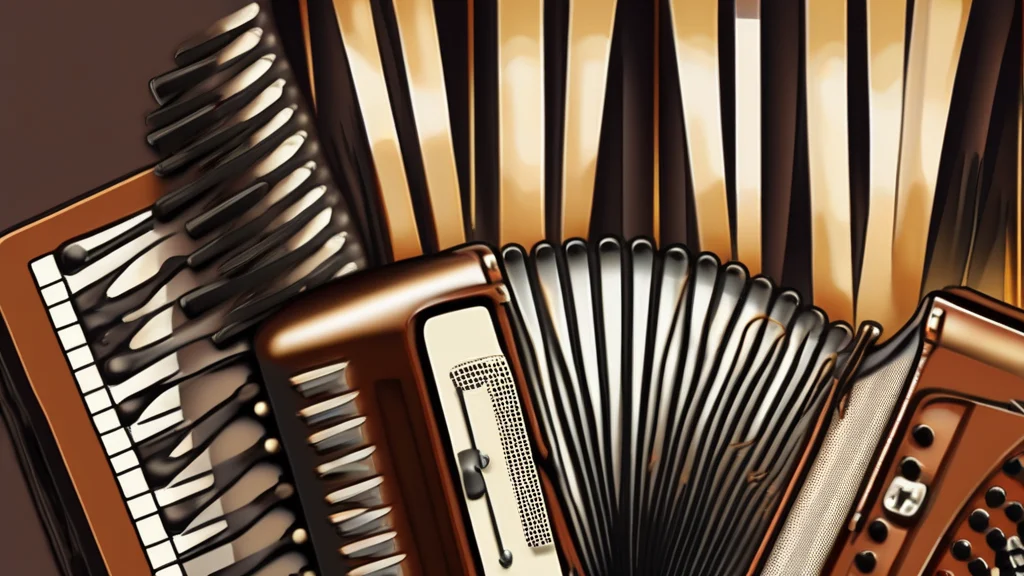
What does accordion mean?
An accordion is a portable musical instrument consisting of a foldable central bellows flanked by two wooden or plastic casings bearing keyboards or rows of buttons. The player expands and contracts the bellows while pressing keys, forcing air across metal reeds to produce its distinctive, richly sustained sound. Closely associated with folk traditions across Europe and the Americas — from French musette and German polka to Mexican norteño and Cajun music — the accordion carries strong cultural connotations of festivity, street performance, and communal dancing. Beyond music, the word also functions attributively to describe anything that folds in a zigzag fashion, such as accordion pleats, doors, or folders. Derived from the musical term 'chord', the name reflects the instrument's ability to sound full harmonies at once, making it essentially a one-person band.
A portable free-reed musical instrument with a bellows, played by pressing keys or buttons while moving the bellows in and out.
"He learned to play the accordion from his grandfather."
Common variants include the piano accordion, which has a piano-style keyboard, and the button accordion.
Describing something folded or able to fold in a zigzag pattern resembling the instrument's bellows.
"She kept her maps in an accordion folder."
Always used attributively before another noun; never stands alone as this sense.
Regular plural; used when referring to multiple instruments or instances.
"The shop displayed dozens of accordions from Germany and Italy."
The accordion was patented in Vienna in 1829 and quickly swept across Europe — today it's the unofficial soundtrack of everything from Parisian cafés to Tex-Mex dance halls.
Reviewed by Deb Chak, Editor. AI-assisted content curated by RJS Tech Solutions LLP.
Etymology of accordion
The word 'accordion' derives from the German 'Akkordion', the name given to the instrument patented by Cyrill Demian in Vienna in 1829. It combines 'Akkord' (chord) with the suffix '-ion', reflecting the instrument's capacity to play chords. 'Akkord' itself traces back through Italian 'accordo' to Latin 'accordare' (to be in harmony), from 'ad-' (to) + 'cor/cordis' (heart). This same Latin root gives English the words 'accord', 'chord', 'concord', and 'discord'.
Related word forms
How accordion is actually used
The word is standard in all registers. As an attributive modifier it describes anything folded in a zigzag pattern resembling the instrument's bellows. The informal British term 'squeezebox' is colloquial.
Easily confused with accordion
A harmonica is a small mouth-blown free-reed instrument held in the hands, whereas an accordion is much larger and played with both hands using a bellows and keys.