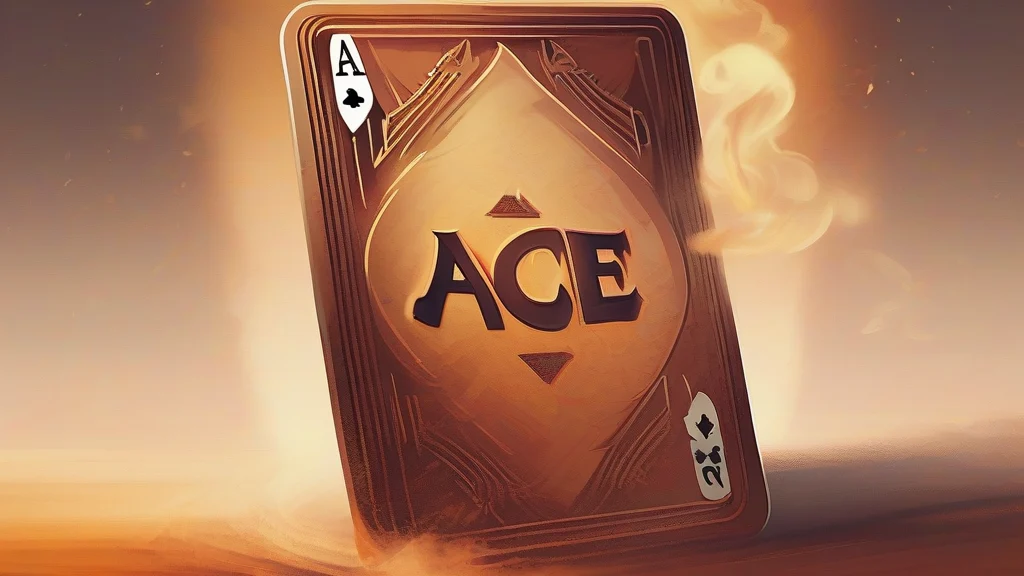
What does ace mean?
An ace is most familiarly the playing card that bears a single pip — traditionally the lowest die face but elevated in most card games to the highest-value card, a reversal that gives the word much of its figurative force. From the card table, "ace" spread to describe any person of outstanding skill: an ace pilot, an ace reporter, an ace at chess. It works equally well as a verb — students ace exams, tennis players hit unreturnable serves called aces, and golfers celebrate a hole-in-one, also called an ace. Informally, British speakers use ace as an adjective meaning excellent, while American speakers favor phrases like "an ace up one's sleeve" for a hidden advantage. Derived from Latin via Old French, the word carries connotations of precision, excellence, and a trump card held in reserve.
A playing card with a single pip, typically ranking highest in its suit; by extension, a person who excels at a particular activity.
"With an ace of spades in hand, she won the trick easily."
To achieve an excellent score or result in a test, course, or challenge; in golf, to complete a hole in one stroke.
"He aced his driving test on the first attempt."
Informal register, especially common in American English.
Excellent or first-rate (informal, chiefly British).
"That new café down the street is absolutely ace."
Chiefly British informal usage.
Standard plural; used both literally for cards and figuratively for experts.
"The dealer dealt him two aces in a row."
In tennis, an 'ace' is a serve so good your opponent never touches it — and the word has been flying off tongues since medieval dice games, where the lowest roll somehow became the highest card.
Reviewed by Deb Chak, Editor. AI-assisted content curated by RJS Tech Solutions LLP.
Etymology of ace
The word "ace" comes from the Old French "as," meaning a unit or the side of a die marked with one spot, which itself derives from the Latin "as," the name of a small Roman coin and unit of weight. When playing cards reached Europe, the single-pip card inherited the name. Its sense expanded from the card itself to anyone who plays it expertly — notably World War I fighter pilots dubbed "aces" for their combat victories — and eventually to the modern verbal sense of excelling at anything.
Related word forms
How ace is actually used
"Ace" as a verb meaning "to excel at" is informal but widely used in American English. In British English it also functions informally as an adjective meaning excellent. The military sense (flying ace) dates from World War I.
Easily confused with ace
An ass is a donkey or a foolish person, whereas an ace is a single-pip playing card or an expert — they sound similar but are unrelated words.