What does acorn mean?
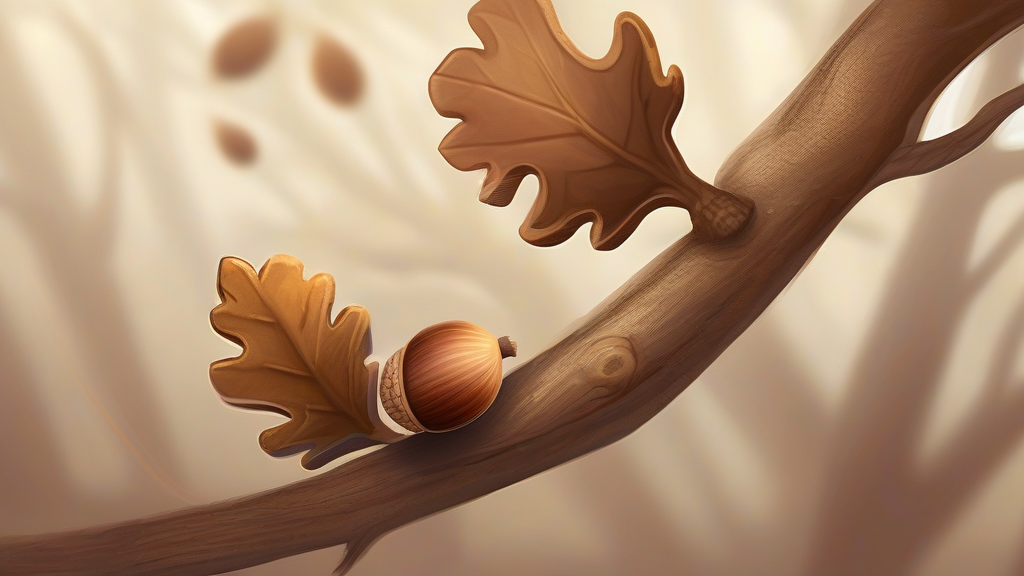
An acorn is the nut of the oak tree: a smooth-shelled, single-seeded fruit that sits in a rough, cup-shaped base known as an acorn cup. It is a countable noun used in ordinary speech about woodland life, wildlife, and gardening, since squirrels, jays, and other animals gather and store acorns each autumn. Beyond its literal meaning, the word carries strong symbolic weight: because a vast oak grows from one small nut, the acorn has long stood for potential, patience, and humble beginnings, most famously in the proverb 'Mighty oaks from little acorns grow.' Historically, acorns also had practical importance, serving as fodder for pigs in European forests and occasionally as food for people in times of scarcity. The word is standard in both British and American English, with no significant regional variation, and its vivid imagery makes it a favorite in literature, children's books, and motivational writing alike.
nounThe nut of the oak tree, typically containing a single seed enclosed in a tough shell and partly surrounded by a scaly cup-shaped base.
- The fruit (nut) of the oak tree, containing a single seed.
- (Historical) Acorns gathered as food for pigs or as a famine food for humans.
"Squirrels buried acorns across the lawn, forgetting many of them, which is how new oaks often begin."
"She picked up a glossy brown acorn and slipped it into her coat pocket."
"In medieval Europe, peasants sometimes fattened their pigs on acorns in the autumn woodlands."
Regular plural; commonly used when referring to quantities gathered by animals or collected by people.
"The forest floor was littered with acorns after the autumn winds."
Every towering oak tree began life as a single acorn — which is why the tiny nut has symbolized potential and patience for centuries.
Reviewed by Deb Chak, Editor. AI-assisted content curated by RJS Tech Solutions LLP.
Etymology of acorn
The word 'acorn' comes from Old English 'æcern', meaning the fruit of the oak. Its earlier origin is debated; it was once popularly linked to 'āc' (oak) plus 'corn' (grain), but modern etymologists consider this folk influence rather than the true source, and the deeper root may be related to words for open land or field, cognate with German 'Ecker'. The spelling shifted to its modern form through Middle English variants such as 'akorne'.
How acorn is actually used
Acorn is a concrete, countable noun used in both everyday and literary contexts. It carries warm, wholesome connotations of nature, growth, and latent potential, and appears frequently in proverbial expressions about small beginnings leading to great outcomes.
Easily confused with acorn
A cone is the woody seed-bearing structure of conifers such as pines, whereas an acorn is the nut of an oak tree.