What does adobe mean?
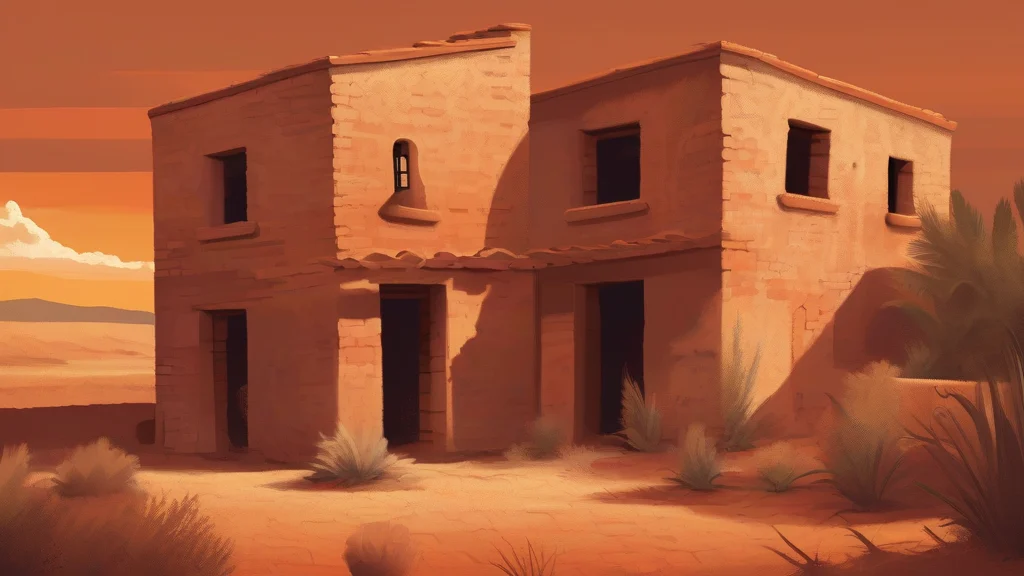
Adobe is a noun referring to a sun-dried brick made from a mixture of clay, sand, water, and often straw or other organic binding material. It also denotes the heavy clay-rich soil from which these bricks are formed. Adobe has been used as a building material for thousands of years across hot, dry regions where wood is scarce, and it remains closely associated with the traditional architecture of the American Southwest, Mexico, and parts of Africa and the Middle East. Structures built of adobe are prized for their thermal mass, which keeps interiors cool by day and warm by night, though the bricks must be protected from prolonged rain. In modern English, 'adobe' frequently appears attributively — as in 'adobe walls', 'adobe house', or 'adobe construction' — and carries connotations of rustic charm, historical continuity, and sustainable, low-impact building. The word itself reflects this long history: it entered English via Spanish from Arabic 'al-ṭūb', meaning 'the brick'.
nounA sun-dried brick made of clay and straw, used as a building material, especially in the southwestern United States and Latin America; also the clay soil from which such bricks are made.
- A sun-dried brick of clay and straw used in building
- The heavy clay soil used to make such bricks
- (attributive) A style of architecture using adobe bricks
"The mission's thick adobe walls kept the interior cool through the desert afternoon."
"They built the ranch house from adobe bricks cast by hand on the property."
"Pueblo communities along the Rio Grande have maintained their adobe dwellings for centuries."
Used when counting individual bricks; uncountable when referring to the material itself.
"Workers stacked hundreds of freshly molded adobes to dry in the sun."
The word 'adobe' traveled from ancient Egyptian 'db.t' (mud brick) through Coptic into Arabic, then Spanish — making it one of the oldest continuously used building words on Earth.
Reviewed by Deb Chak, Editor. AI-assisted content curated by RJS Tech Solutions LLP.
Etymology of adobe
The word 'adobe' entered English in the mid-eighteenth century from Spanish, which had borrowed it from Arabic 'al-ṭūb' ('the brick'), a term that spread with Moorish influence in Spain. The Arabic word itself traces back further, likely to an Egyptian Coptic source for mud brick, reflecting the extremely ancient use of sun-dried bricks in North Africa and the Middle East. Related forms appear in Spanish verbs like 'adobar' (to plaster or coat). The term became established in English primarily through descriptions of the architecture of Mexico and the southwestern United States.
How adobe is actually used
Often used attributively ('an adobe house', 'adobe walls'). Strongly associated with Southwestern US and Spanish Colonial architecture. The plural is unchanged in form when referring to the material, but 'bricks' is often added for countable use.
Easily confused with adobe
The building material 'adobe' is a sun-dried clay brick, whereas Adobe Inc. is a software company whose name was chosen after the Adobe Creek near its founders' homes.