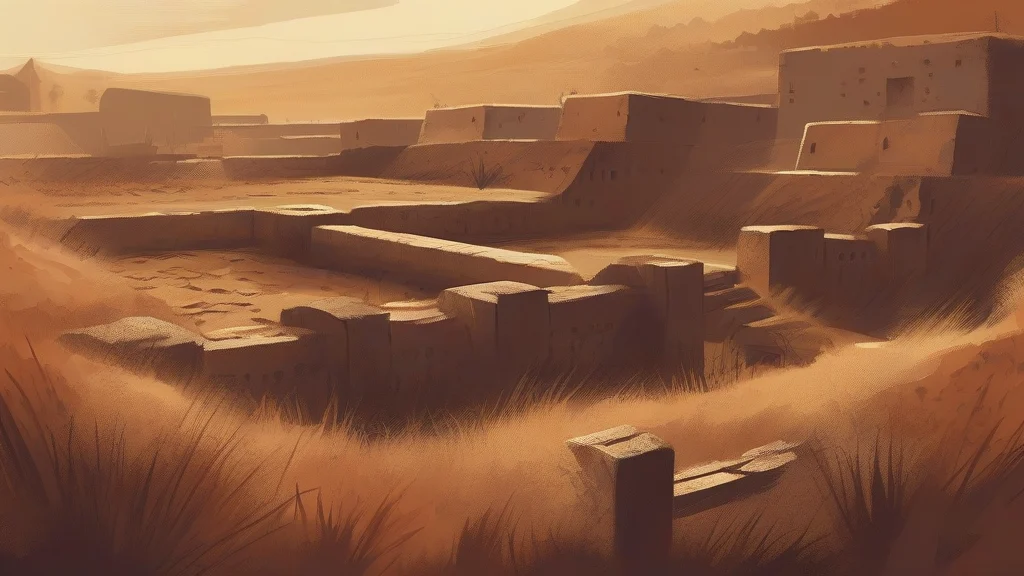
What does agger mean?
An agger is an embankment or rampart made of earth, best known as a defining feature of Roman military engineering. When a Roman army halted for even a single night, its soldiers dug a ditch (the fossa) and threw the excavated soil inward to form a raised bank — the agger — encircling the camp as a defense against surprise attack. In more permanent forts and siegeworks, aggers could be substantial structures, sometimes reinforced with timber or stone. Today the word survives chiefly as a technical term in archaeology and classical scholarship, where identifying the remnant of an agger helps researchers locate and map ancient Roman sites. Though rare in general conversation, it carries a precise, evocative connection to the discipline and mobility of the Roman legions, whose daily earthworks were a hallmark of their military system.
nounAn embankment or rampart of earth, especially one forming part of the defensive earthworks of a Roman military camp or fortification.
- A rampart or embankment of earth, especially the defensive bank surrounding a Roman military camp or fortification.
- In archaeology, the surviving bank of such ancient earthworks, used as a diagnostic feature in identifying and mapping Roman sites.
"The archaeologists traced the line of the Roman agger along the eastern edge of the old fortress."
"Surveyors identified the agger of the marching camp by its distinctive low, broad profile across the field."
"The legionaries threw up an agger around the perimeter each evening before pitching their tents."
The plural follows the standard English pattern; it appears when describing multiple banks or the earthworks of several sites.
"Excavations revealed the aggers of two successive marching camps on the ridge."
Every time you say "exaggerate," you're echoing the Latin word for a Roman army's dirt rampart — to exaggerate originally meant to pile up an agger even higher.
Reviewed by Deb Chak, Editor. AI-assisted content curated by RJS Tech Solutions LLP.
Etymology of agger
Agger comes directly from Latin agger, meaning a heap, mound, or rampart of earth, which was the standard term for the defensive banks of Roman camps and fortifications. The Latin noun derives from the verb aggerere, "to heap up" or "bring toward," itself formed from ad- ("toward") plus gerere ("to carry"). The same root underlies English "exaggerate," which entered English via Latin exaggerare, literally "to heap up" — so the everyday act of exaggerating preserves a fossil of Roman military vocabulary. The word was adopted into English antiquarian and archaeological writing, where it remains in technical use.
How agger is actually used
Agger is a technical term used mainly in archaeology, classical studies, and military history rather than everyday speech. It most often appears in discussions of Roman fortifications, where it denotes the earthen bank that, together with an accompanying ditch (fossa), formed a camp's defenses. The plural is typically anglicized as "aggers."
Easily confused with agger
"Agger" is the noun meaning an earthen rampart, while "aggerate" is a rare verb form relating to heaping up earth.
An auger is a tool for boring holes, whereas an agger is an embankment of earth.