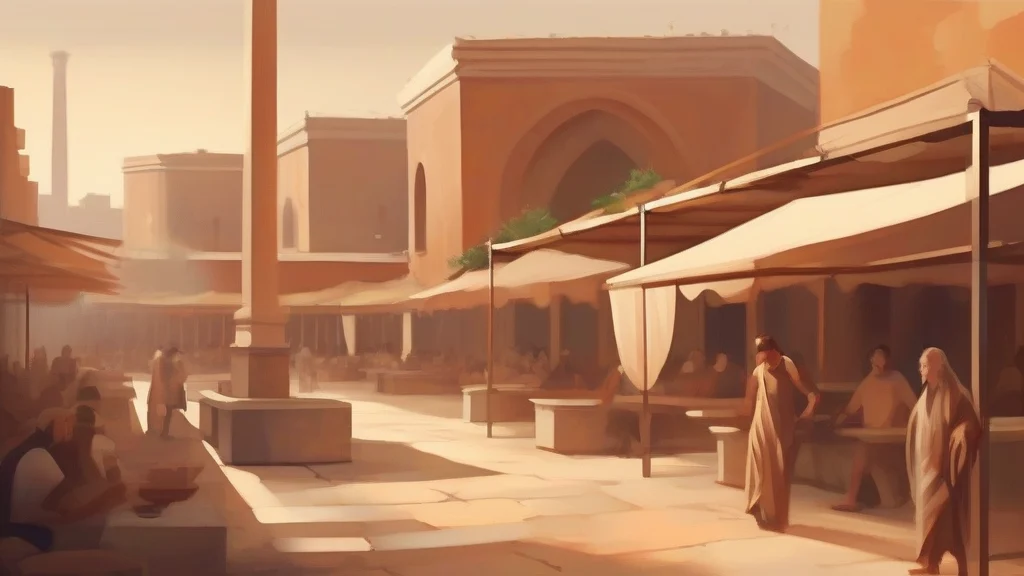
What does agora mean?
An agora was the open public square that stood at the heart of every major ancient Greek city, functioning simultaneously as a marketplace, a civic center, and a social hub. In Athens, the agora was where citizens bought and sold goods, exchanged news, conducted legal business, and gathered to discuss politics — it was, in essence, the beating heart of public life. The word derives from the Greek verb ageirein, meaning 'to gather,' reflecting the square's role as a place of assembly. Today, 'agora' appears chiefly in historical, archaeological, and architectural contexts, describing both specific excavated sites, such as the famous Agora of Athens, and the general concept of a communal urban space. Its legacy endures in the modern term 'agoraphobia,' which literally denotes fear of open or crowded public spaces. The standard plural is 'agorae,' though 'agoras' is widely accepted.
nounIn ancient Greece, an agora was the public open space in a city that served as a marketplace and a gathering place for civic, political, and commercial life. The term can also refer more generally to any similar public meeting place or marketplace.
- The open public square in an ancient Greek city, serving as a marketplace and center of civic and political life.
- By extension, any comparable public gathering place or marketplace.
"Merchants and philosophers alike crowded into the agora at the heart of ancient Athens."
"Citizens gathered daily in the agora to trade goods and debate the affairs of the polis."
"Archaeologists have uncovered the remains of a large agora at the center of the excavated city."
The Latinate-style plural 'agorae' is conventional in academic and archaeological writing; the anglicized 'agoras' is also common and acceptable.
"Excavations across the Aegean have revealed several well-preserved agorae."
The word 'agoraphobia' literally means 'fear of the marketplace' — it comes straight from the Greek agora, the bustling public square where Athenians shopped, argued politics, and heard Socrates talk.
Reviewed by Deb Chak, Editor. AI-assisted content curated by RJS Tech Solutions LLP.
Etymology of agora
The English word 'agora' comes directly from the ancient Greek ἀγορά (agorá), meaning 'assembly' or 'marketplace,' which in turn derives from the Greek verb ageirein, 'to gather.' It ultimately traces back to the Proto-Indo-European root *ger-, 'to gather together,' making it a distant cousin of Latin-derived words such as 'gregarious' and 'aggregate.' The term entered English in the late sixteenth or early seventeenth century through scholarly writing on classical antiquity, and it remains closely tied to descriptions of Greek civic architecture and urban life.
Related word forms
How agora is actually used
Agora is primarily a historical and archaeological term, encountered in discussions of ancient Greece rather than everyday speech. The plural is conventionally 'agorae' in scholarly writing, though 'agoras' is also accepted.
Easily confused with agora
An agora was the low-lying public square used for commerce and assembly, while the acropolis was the fortified high point of a Greek city, typically home to its most important temples.