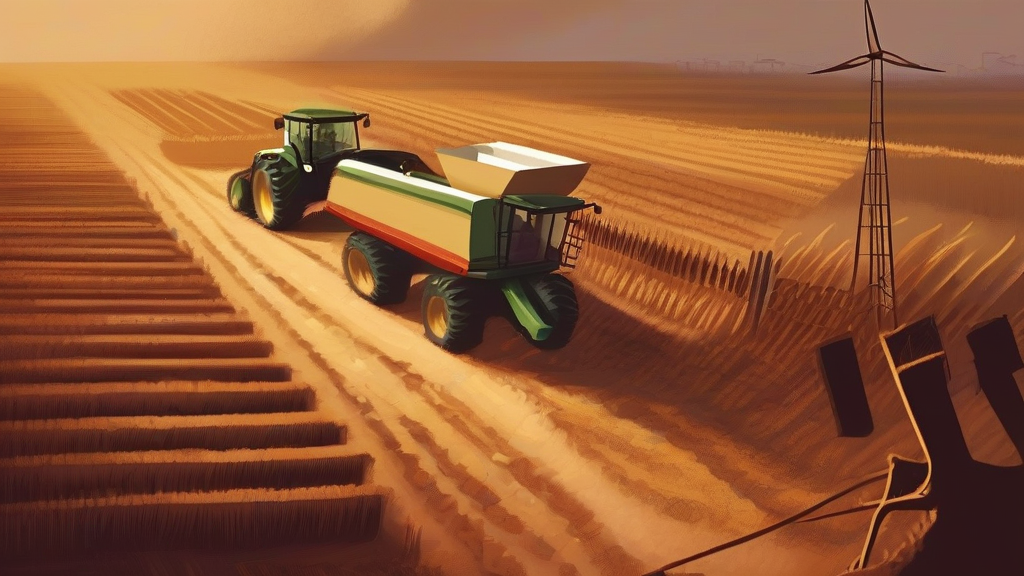
What does agroindustrial mean?
"Agroindustrial" is an adjective describing the fusion of agriculture with industrial methods—large-scale, mechanized, technology-driven farming and the industrial processing of crops and livestock into food, fuel, and raw materials. It appears most often in economics, policy debates, and environmental writing, where it labels everything from an "agroindustrial complex" to "agroindustrial waste." The term is largely neutral in itself but frequently acquires a critical edge in discussions of sustainability, since it evokes monocultures, factory farms, and the displacement of traditional smallholders; conversely, it can signal modernization, efficiency, and food security in development contexts. Built from the Latin-rooted combining form "agro-" (field, soil) joined to "industrial," it belongs to a family of technical compounds like agronomy and agroecology. For readers of news about global food systems, land use, or rural economies, it is an essential term for naming the dominant model of modern food production.
adjectiveRelating to or involving both agriculture and industry, especially the large-scale, mechanized processing of farm products or the integration of farming with industrial production.
- Relating to the combined activities of agriculture and industry, particularly the large-scale industrial processing of agricultural products.
- Describing regions, economies, or enterprises characterized by intensive, mechanized, technology-driven farming integrated with food processing.
"The region's economy shifted from small family farms to a vast agroindustrial complex dominated by grain processors and meatpacking plants."
"Critics argue that the agroindustrial model prioritizes yield and profit over soil health and biodiversity."
"Government investment transformed the river delta into a major agroindustrial hub for sugar refining and ethanol production."
The word 'agroindustrial' captures one of the biggest transformations in human history: the moment when farming stopped being a way of life and became an industry.
Reviewed by Deb Chak, Editor. AI-assisted content curated by RJS Tech Solutions LLP.
Etymology of agroindustrial
The word combines "agro-", a combining form from the Latin "ager" (field), with "industrial," which derives ultimately from the Latin "industria" meaning diligence or activity. Compounds of this type arose in the nineteenth and twentieth centuries as farming became mechanized and integrated with manufacturing, with parallel forms appearing across European languages (such as French "agro-industriel" and Spanish "agroindustrial"). Its cognates include other "agro-" formations like agronomy and agroecology, all tracing back to the same Latin root for cultivated fields.
How agroindustrial is actually used
Primarily used in formal, academic, economic, and policy contexts such as development economics, environmental writing, and agricultural science. It often carries a neutral-to-critical connotation depending on context: proponents use it to describe modernization and efficiency, while critics invoke it when discussing environmental degradation, consolidation of farmland, or the decline of smallholder farming. It is more common in international and European English than in everyday American speech, where terms like "agribusiness" are often preferred for the noun concept.
Easily confused with agroindustrial
"Agricultural" refers to farming itself, while "agroindustrial" specifically describes the intersection of farming with industrial-scale processing and manufacturing.