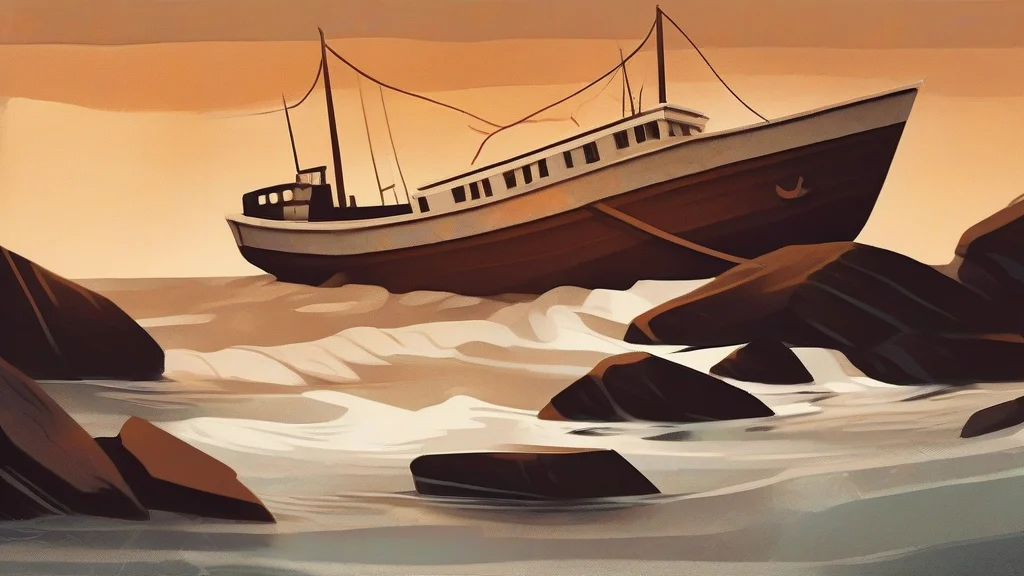
What does aground mean?
Aground describes a ship or boat that has become stranded on the seabed, on sand, or on rocks, so that it can no longer float or steer freely. It functions as both an adjective and an adverb, and it appears overwhelmingly in the fixed phrases 'run aground' and 'go aground', which describe the act of becoming stranded. Although rooted firmly in maritime language, the word has developed a well-established figurative life: negotiations, businesses, careers, and plans are said to have 'run aground' when they stall or come to nothing. The word carries connotations of mishap and helplessness — a vessel aground is at the mercy of tides and weather until it can be refloated. Its structure is transparent: the prefix 'a-' indicates a state or condition, just as in 'afloat' or 'asleep', so 'aground' literally means 'in the condition of being on the ground'. Compact, vivid, and instantly understood, it remains indispensable in both news reporting and everyday metaphor.
(Of a ship or boat) stranded on the ground or on rocks in shallow water, unable to float or move.
"The trawler lay aground on the mudflats until the tide returned."
Used almost exclusively predicatively.
Into or onto the ground; so as to be stranded (used chiefly with verbs like 'run' or 'go').
"The yacht went aground near the harbour mouth."
Every shipwreck story starts with two little letters: 'a-' — the same prefix that turns 'sleep' into 'asleep' turns 'ground' into disaster.
Reviewed by Deb Chak, Editor. AI-assisted content curated by RJS Tech Solutions LLP.
Etymology of aground
Aground comes from Middle English, formed from the prefix 'a-' (from Old English 'on', meaning 'on' or 'in a state of') combined with 'ground', meaning the solid earth or seabed. It belongs to a family of English words built the same way, including 'afloat', 'ashore', and 'aboard', all describing a vessel's condition relative to its surroundings. The word has been used in nautical contexts since at least the early modern period and retains that flavor today, while also extending figuratively to any enterprise that has stalled.
How aground is actually used
Almost always used predicatively ('the ship was aground') rather than attributively ('an aground ship' is rare). The verb phrase 'run aground' is by far the most common construction and works for both literal nautical use and figurative use about projects or plans. Nautical register but widely understood.
Easily confused with aground
'Around' means surrounding or encircling something, while 'aground' describes a vessel stranded on the seabed — they look similar but share no meaning.