What does aigrette mean?
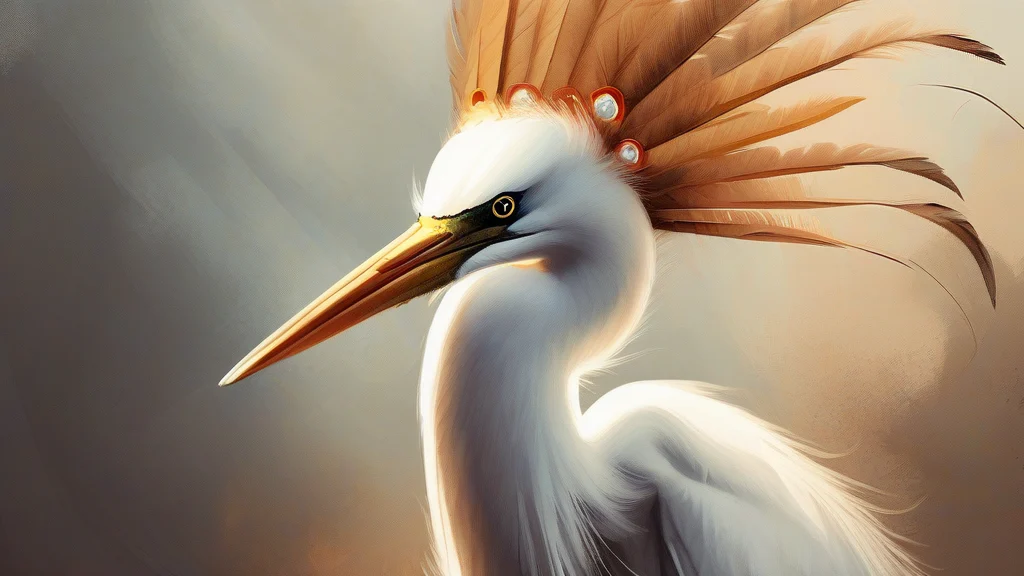
An aigrette is a decorative spray of feathers or jewels worn on the head, classically fashioned from the long breeding plumes of egrets or herons and mounted in a tiara, comb, or headdress. By the late nineteenth century it had become one of the signature ornaments of formal court dress and high society, and jewelers produced dazzling diamond versions that required no feathers at all. The word also serves as a name for the egret itself — the elegant white heron whose plumage gave the ornament its name — and, more technically, for a tuft of feathery hairs found on certain plants. Borrowed from French, which took it from Provençal, aigrette ultimately derives from the same Germanic root as 'heron'. Today the term appears mostly in discussions of antique jewelry, fashion history, and ornithology, carrying connotations of glamour, rarity, and a bygone era of elaborate personal adornment. Its association with egret plumes also recalls early conservation campaigns that helped end the trade in ornamental bird feathers.
A spray of feathers or jewels worn as an ornament on the head, especially a plume of egret or heron feathers set in a headdress.
"The duchess wore a diamond aigrette at the coronation."
Most commonly used today in jewelry and fashion-history contexts.
A small white heron; an egret.
"Great aigrettes once nested in vast colonies across the Florida wetlands."
A tuft of feathery hairs or bristles on a plant, as on certain seeds or flower heads.
"Each thistle seed carries a silky aigrette that aids its flight."
Standard plural; simply add -es? No — standard plural adds -s: aigrettes. Both the ornament and the bird use this regular plural.
"The museum displayed several jeweled aigrettes from the Belle Époque."
Fashion's most glamorous word for a feather — 'aigrette' comes from the same French root as 'egret', so every jeweled tiara spray literally borrows its name from a wading bird.
Reviewed by Deb Chak, Editor. AI-assisted content curated by RJS Tech Solutions LLP.
Etymology of aigrette
Aigrette entered English from French in the seventeenth century, where it meant both the egret bird and the tuft of plumes taken from it. The French word derives from Provençal 'aigreta', a diminutive formed from 'aigron' (heron), which traces back through Old High German 'heigaro' to a Germanic root shared with English 'heron'. Over time the meaning shifted from the bird's plume itself to any jeweled or feathered head ornament shaped like such a spray.
How aigrette is actually used
Formal and somewhat old-fashioned in tone; chiefly encountered in historical, fashion, or jewelry contexts. The ornamental sense dominates modern usage, while the botanical sense is largely technical.
Easily confused with aigrette
An egret is the white heron-like bird itself, while an aigrette is either the ornamental feather spray made from such birds or the jewel ornament imitating it.