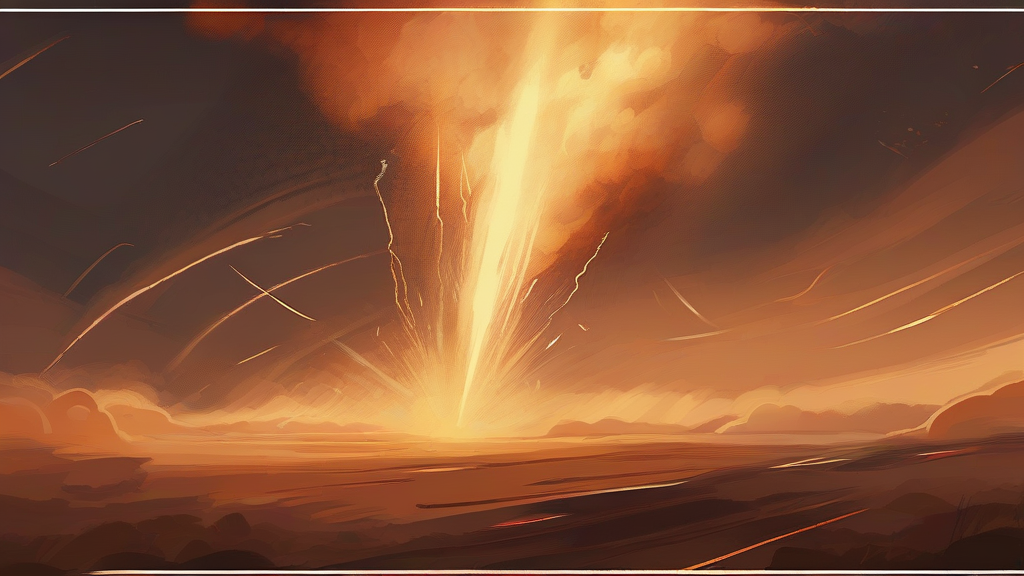
What does airburst mean?
An airburst is the explosion of a bomb, shell, grenade, or other munition in the air rather than at the point of impact. The effect is usually achieved with a timed or proximity fuze that triggers detonation at a predetermined altitude. Military forces favour airbursts because an explosion above the ground distributes blast waves and fragments over a broader area than a ground-level detonation, making them especially effective against exposed personnel, unarmoured vehicles, and targets behind cover such as trenches. The term also appears in planetary science, where it describes objects like meteoroids that explode in the atmosphere before reaching the surface — the 1908 Tunguska event is the most famous example. Airburst is a specialised noun found mainly in military, historical, and scientific writing, and it contrasts directly with a groundburst, which occurs on or below the surface.
nounAn explosion of a bomb, shell, or other munition in the air rather than upon impact with the ground or a target.
- The detonation of an explosive device in the air, especially as a deliberate tactic to maximize blast and fragmentation effects over a target area.
"The artillery shell was fuzed for an airburst, scattering fragments over a wide area above the trench line."
"The mortar rounds were set for airburst so the shrapnel would rain down on the entrenched defenders."
"Meteorologists noted that the Tunguska event of 1908 was likely an airburst caused by a meteoroid exploding several kilometres above Siberia."
Standard pluralization; used when referring to multiple such explosions, e.g. across a barrage or a series of meteor events.
"The barrage produced dozens of airbursts above the ridge line."
Military planners deliberately detonated some of history's most destructive bombs in mid-air — because an airburst spreads its blast far wider than one that hits the ground.
Reviewed by Deb Chak, Editor. AI-assisted content curated by RJS Tech Solutions LLP.
Etymology of airburst
Airburst is a compound of 'air', ultimately derived from the Greek 'āēr' (lower atmosphere) via Latin 'aer', and 'burst', from Old English 'berstan', meaning to break open suddenly. The compound emerged in English during the era of modern artillery and aerial bombardment, as fuzes capable of timing detonations in flight became widespread around the First World War. It shares its components with related terms such as 'aerial' and the verb 'burst' itself.
How airburst is actually used
Airburst is a technical term used chiefly in military, ordnance, and scientific contexts; it is rare in everyday conversation. It carries no strong emotional connotation outside discussions of warfare, where it can evoke the devastation of aerial bombardment and nuclear weapons.
Easily confused with airburst
A groundburst is an explosion that occurs on or beneath the surface, whereas an airburst detonates in the air above the target.