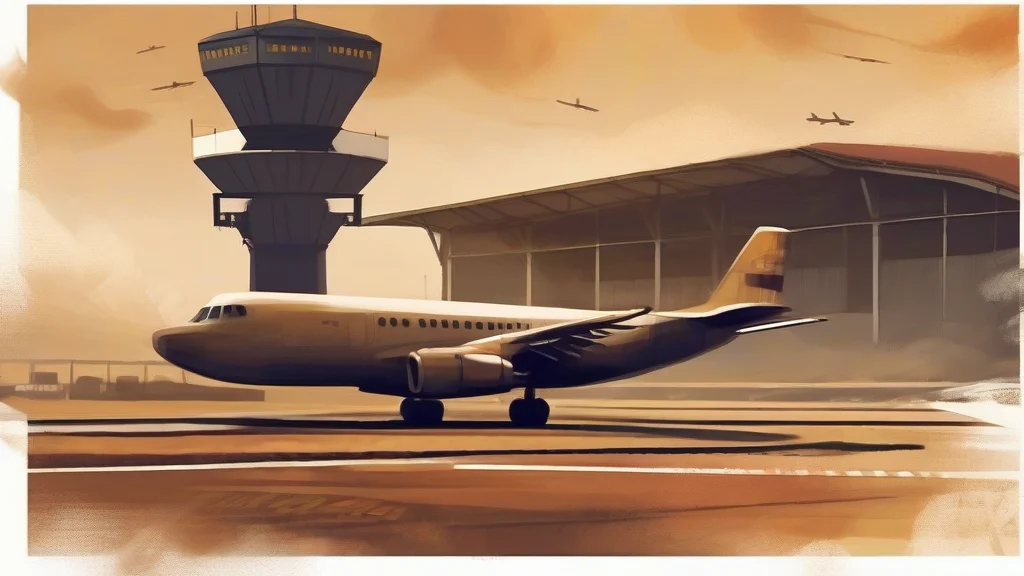
What does airfield mean?
An airfield is an area of open ground prepared for aircraft to take off and land, typically featuring one or more runways along with modest supporting structures such as hangars or fuel stores. The term describes a class of flying site smaller and less developed than an airport: where an airport offers passenger terminals, shops, and scheduled commercial service, an airfield may be little more than a grass strip serving light aircraft, gliders, or crop-dusters. Airfields are strongly associated with military aviation — many were hastily built during the World Wars — as well as with rural and recreational flying. Common collocations include 'military airfield', 'abandoned airfield', and 'grass airfield', reflecting both its martial heritage and its humble scale. Closely related terms include 'aerodrome' (the older British official term), 'airstrip' (a bare runway without facilities), and 'airbase' (a military installation). For readers, 'airfield' is a useful word precisely because it occupies this middle ground: more than a strip of tarmac, less than a transport hub.
nounAn airfield is an area of open ground, typically with one or more runways, from which aircraft take off and land. It is generally a smaller or less elaborate facility than a full airport, often lacking extensive passenger terminals.
- A tract of open ground equipped for the takeoff and landing of aircraft, usually smaller and less developed than an airport.
"The small airfield outside the village had been used by crop-dusters since the 1950s."
"Pilots practicing touch-and-go landings circled the quiet airfield all afternoon."
"The wartime airfield, long abandoned, is now home to a popular motorsport circuit."
Standard pluralization; commonly used when discussing multiple sites, e.g. in historical or regional surveys.
"Dozens of disused airfields across the region have been converted to solar farms."
Many of Britain's WWII airfields still scar the countryside today — their concrete runways repurposed as racetracks, storage yards, or simply left to crumble into farmland.
Reviewed by Deb Chak, Editor. AI-assisted content curated by RJS Tech Solutions LLP.
Etymology of airfield
The word 'airfield' combines 'air', ultimately from Latin-derived roots relating to the atmosphere, with 'field', from Old English 'feld', meaning open or cultivated ground. It emerged in English during the early twentieth century, as powered flight created the need for designated landing grounds. Its formation parallels other early aviation compounds such as 'aircraft' and 'airplane'. Related terms sharing the aerial root include 'aerial', 'aeronautics', and 'aeroplane'.
How airfield is actually used
The term carries a practical, slightly utilitarian connotation and is especially associated with military aviation and small private or rural flying sites. In British usage it overlaps heavily with 'aerodrome', an older term still common in official contexts. 'Airfield' implies less infrastructure than 'airport' and is rarely applied to major commercial hubs.
Easily confused with airfield
An airport is a larger facility with terminals and commercial services for passengers, whereas an airfield is a simpler area of ground used mainly for aircraft takeoff and landing.
An airstrip is a single runway or landing surface, while an airfield is the broader site that may include runways plus hangars, buildings, and other supporting facilities.