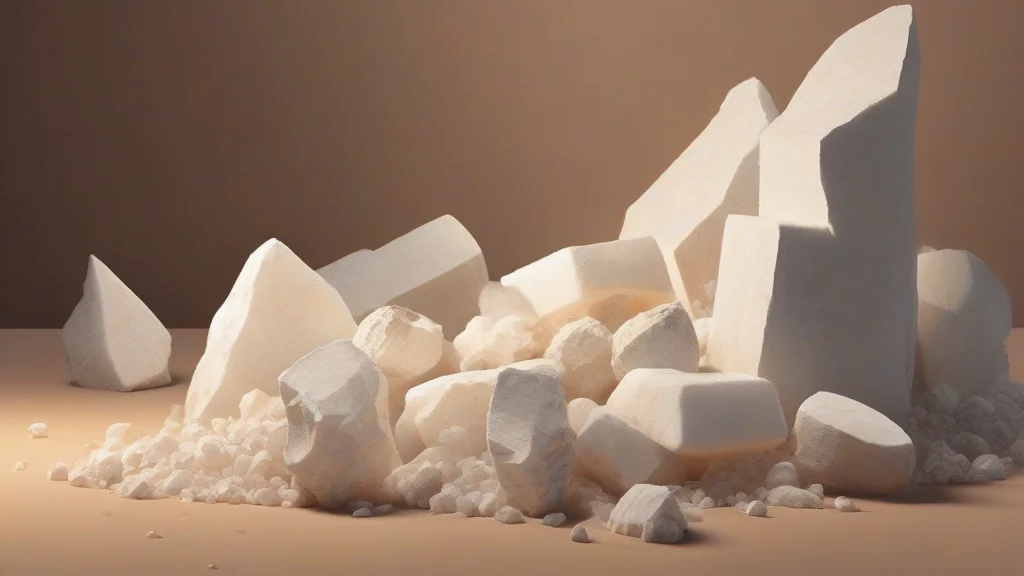
What does albite mean?
Albite is a common rock-forming mineral belonging to the feldspar group, the most abundant group of minerals in the Earth's crust. Chemically it is sodium aluminium silicate, NaAlSi₃O₈, and it forms the sodium-rich end member of the plagioclase feldspar series, grading continuously into calcium-rich anorthite. Typically white, colourless, or pale grey — hence its name, derived from the Latin word for white — albite occurs widely in granites, pegmatites, and metamorphic rocks, where it may form blocky or platy crystals with a vitreous to pearly lustre. Certain translucent varieties display an attractive bluish iridescence and are cut as moonstone. Because of its abundance and chemical behaviour, albite is important in petrology: its composition helps geologists interpret the origin and evolution of igneous rocks. Although primarily a term of mineralogy and geology, it also interests collectors and lapidaries who value its attractive crystalline habits and gem varieties.
nounA white or colourless mineral of the feldspar group, sodium aluminium silicate (NaAlSi₃O₈), that is a common constituent of igneous rocks such as granite and pegmatite and is the sodium-rich end member of the plagioclase series.
- A white or colourless sodium aluminium silicate mineral of the feldspar group, the sodium end member of the plagioclase series, common in igneous and metamorphic rocks.
"The pegmatite veins were studded with blocky crystals of milky albite."
"Thin sections of the granite revealed interlocking grains of quartz, orthoclase, and albite."
"Collectors prize the bladed cleavelandite variety of albite for its pearly lustre and delicate platy habit."
As a mineral species, albite is usually treated as an uncountable mass noun; the plural 'albites' appears mainly when referring to distinct crystals, specimens, or occurrences.
"The museum's collection includes albites from localities across Scandinavia and North America."
Albite gets its name from Latin 'albus' — white — because it so often appears as a chalky white mineral, yet gem-quality varieties can glow with blue iridescence known as moonstone sheen.
Reviewed by Deb Chak, Editor. AI-assisted content curated by RJS Tech Solutions LLP.
Etymology of albite
The word 'albite' was coined from the Latin 'albus', meaning white, reflecting the mineral's characteristic milky-white appearance. It was introduced by Swedish chemist Johan Gottlieb Gahn and Jöns Jacob Berzelius in the early 19th century, drawing on earlier descriptions of the mineral from Scandinavian localities. The same Latin root 'albus' gives English several other words, including 'albedo', 'albumen', and 'album', all carrying a sense of whiteness or brightness.
How albite is actually used
Albite is a technical term used chiefly in mineralogy, geology, and petrology; it rarely appears in general conversation. It is uncountable as a mineral species but may be referred to in plural when discussing individual crystals or specimens. The name refers to its typical white colour rather than to any property of the element aluminium.
Easily confused with albite
Anorthite is the calcium-rich end member of the same plagioclase feldspar series, whereas albite is its sodium-rich end member.
Microcline is a potassium feldspar often found alongside albite in pegmatites, but it has a different chemical composition and crystal structure.