What does alembic mean?
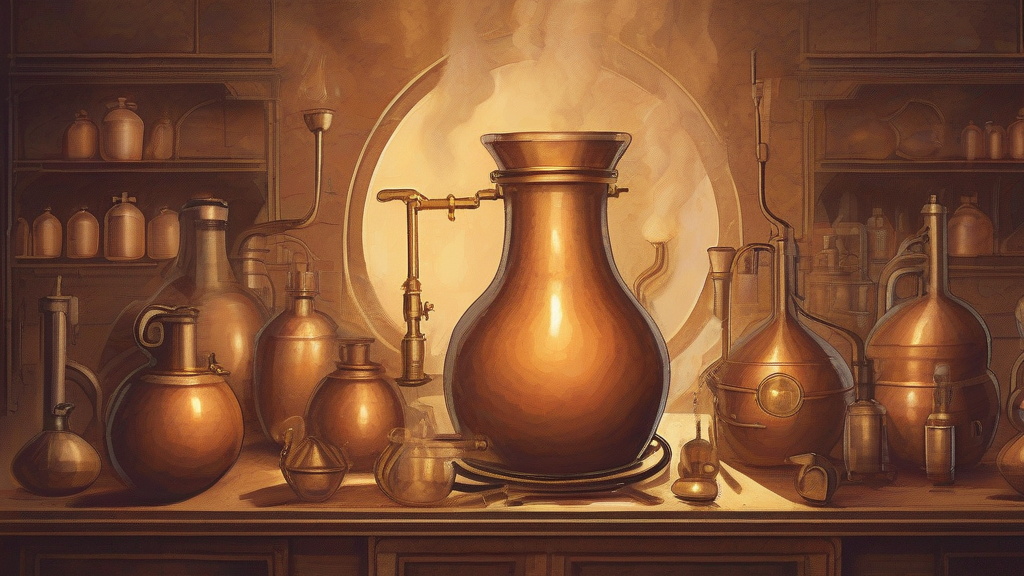
An alembic is a piece of distillation equipment used from antiquity through the early modern period, consisting of a vessel (the cucurbit) in which liquid is heated and a domed head that collects and condenses the vapour, channeling it down a spout into a receiver. Alembics were central to the work of alchemists and early chemists distilling spirits, oils, acids, and medicines, and they remain familiar today as symbols of the alchemical laboratory. Beyond its literal meaning, the word has developed a well-established figurative sense: writers use 'an alembic of' to describe any intense process that refines or transforms — for example, describing suffering or experience as an alembic that distils character. The word carries connotations of mystery, transformation, and scholarly tradition, and it belongs to formal register rather than everyday speech. Its journey through Greek, Arabic, and medieval Latin into English makes it a small monument to the history of science itself.
A distilling apparatus consisting of a heating vessel and a condensing head, used especially in alchemy and early chemistry.
"The apothecary filled the alembic with rose petals and water to distil a precious attar."
Often used with the definite article when referring to the apparatus generically: 'the alembic'.
(Figurative) A place or process of transformation or refinement, likened to distillation.
"The city was an alembic in which immigrants from a dozen nations were fused into a single community."
Almost always used in the phrase 'an alembic of' followed by the transforming force or place.
Standard plural formation; used when referring to multiple apparatuses, e.g. in descriptions of laboratories or historical collections.
"The museum displayed a row of gleaming glass alembics from seventeenth-century pharmacies."
The word 'alembic' travelled from Greek through Arabic into English — a linguistic journey that mirrors the very act of distillation it describes.
Reviewed by Deb Chak, Editor. AI-assisted content curated by RJS Tech Solutions LLP.
Etymology of alembic
Alembic entered English in the Middle Ages via Old French and medieval Latin, ultimately deriving from the Arabic al-anbīq ('the still'), which itself came from the Greek ambix, meaning a cup or the cap of a still. The Arabic article 'al-' prefixed to the Greek root gave the word its distinctive form, making it one of many scientific terms English absorbed through Arabic scholarship during the transmission of alchemical knowledge to Europe. Cognates appear across European languages, including French alambic and Spanish alambique.
How alembic is actually used
Alembic is a formal, somewhat literary word. In modern usage it appears most often in historical writing about alchemy and chemistry, and figuratively in literary prose to describe transformative experiences. It is rare in everyday conversation.
Easily confused with alembic
An albino is an organism lacking pigment, whereas an alembic is a distilling vessel; the words merely share a superficial visual similarity.
A retort is a single-vessel distillation apparatus with a long downward-bent neck, while an alembic comprises two linked vessels — a boiling pot (cucurbit) and a condensing head.