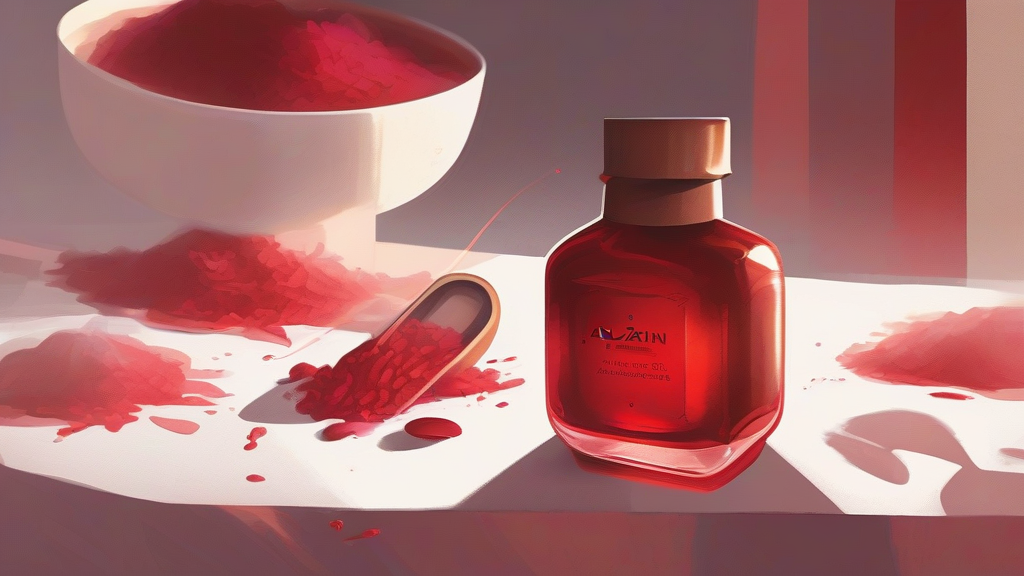
What does alizarin mean?
Alizarin is an organic compound best known as the brilliant red dye historically extracted from the roots of the madder plant, which has been cultivated for coloration since antiquity. Chemically, it is a derivative of anthraquinone, and since the late 1860s it has been manufactured synthetically, a development that transformed the economics of the dye industry and helped establish modern industrial chemistry. Today the word appears most often in discussions of art materials — 'alizarin crimson' remains a staple pigment on painters' palettes — as well as in histology and chemistry, where alizarin compounds serve as stains that bind to calcium, highlighting bone and mineral deposits under the microscope. Although technical in register, the term carries rich historical associations, evoking centuries of textile craft, trade in natural dyestuffs, and the nineteenth-century shift from agriculture-based colorants to laboratory synthesis. For anyone interested in art history, chemistry, or the material culture of color, alizarin offers a compact example of how a single molecule links ancient craft to modern science.
nounA bright red crystalline compound that is the principal coloring matter of madder root, used chiefly as a dye and pigment; it is now typically produced synthetically.
- The red dye compound obtained originally from madder roots and now made synthetically, used to color textiles, produce artists' pigments such as alizarin crimson, and serve as a biological stain.
- By extension, any of various dyes and pigments based on this compound or closely related derivatives.
"The textile conservator identified the faded red threads as having been dyed with alizarin derived from madder root."
"The artist squeezed a ribbon of alizarin crimson onto her palette, its deep cool red unlike any other hue in her set."
"In histology laboratories, alizarin is used to stain calcium deposits, turning bone tissue a vivid red under the microscope."
As an uncountable substance noun, alizarin normally takes no plural; a plural form is used only when referring to distinct varieties or derivative compounds of the dye.
"Several synthetic alizarins were tested for lightfastness before the museum chose a replacement pigment."
For centuries Europe's finest red came from plant roots grown on Dutch farms — until 1869, when German chemists figured out how to make alizarin in a lab and wiped out the madder industry almost overnight.
Reviewed by Deb Chak, Editor. AI-assisted content curated by RJS Tech Solutions LLP.
Etymology of alizarin
The word alizarin entered English in the early nineteenth century from French 'alizari', which itself derives from Arabic al-'uṣāra, literally 'the juice', referring to the juice pressed from madder roots. It belongs to the large family of English words absorbed through Arabic scientific and commercial vocabulary during the medieval period, alongside terms such as alcohol, alkali, and alchemy, which similarly carry the Arabic definite article 'al-' at their head. The name became firmly established after the compound's isolation from madder in the 1820s and its subsequent synthesis in 1869 by chemists working independently in Germany and England.
How alizarin is actually used
Alizarin is primarily encountered in technical contexts — dyeing, fine-art pigments, histology, and analytical chemistry — rather than everyday speech. The term 'alizarin crimson' names one of the most widely recognized pigments among painters. In older texts the variant spelling 'alizarine' appears, reflecting nineteenth-century chemical nomenclature conventions.
Easily confused with alizarin
Carminic acid is the red coloring agent of cochineal insects, whereas alizarin is the red coloring agent of madder root.