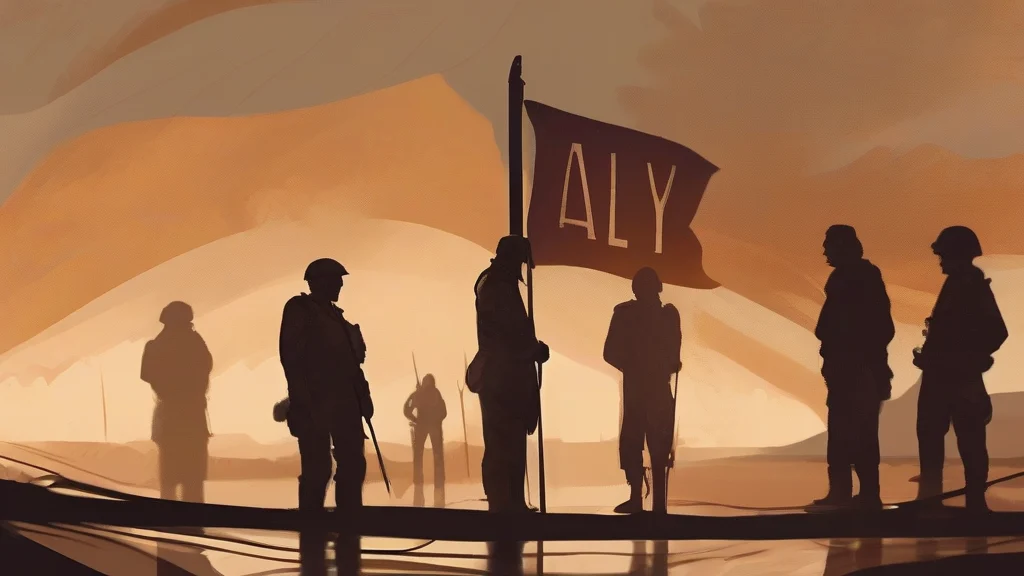
What does ally mean?
An ally is a person, group, or nation that joins forces with another in pursuit of a shared goal, most commonly in war, politics, or diplomacy. The term carries strongly positive connotations of loyalty, trust, and mutual support, which is why phrases like 'trusted ally' and 'close ally' are so frequent in political discourse. Historically, 'the Allies' refers to the great coalitions of the First and Second World Wars, giving the word a weight beyond everyday friendship. As a verb, to ally means to unite or bind together, typically expressed as 'ally oneself with' a cause or party. In contemporary usage the word has broadened into social contexts, where an ally is someone who supports a community or movement they are not personally part of. Derived from the Latin alligare, 'to bind to', the word's very etymology captures its essence: an ally is someone bound to you by common purpose.
A person, group, or nation that joins or supports another for a common purpose, especially in war or politics.
"Portugal, Britain's oldest ally, signed the treaty in 1373."
Plural is 'allies'; the capitalized plural 'the Allies' specifically denotes the WWI and WWII coalitions.
To unite or bind together, especially to form a political or military partnership; usually reflexive as 'ally oneself with'.
"The smaller parties allied themselves with the opposition to block the bill."
Pronounced /əˈlaɪ/ with stress on the second syllable.
Standard plural; when capitalized as 'the Allies', it refers specifically to the World War coalitions.
"The Allies liberated Paris in August 1944."
The word 'Allies' named the coalition that defeated Nazi Germany — and it comes from the same Latin root as 'ligament', literally meaning 'to bind together'.
Reviewed by Deb Chak, Editor. AI-assisted content curated by RJS Tech Solutions LLP.
Etymology of ally
The word 'ally' entered English in the Middle Ages from Old French 'alier', itself derived from the Latin 'alligare', meaning 'to bind to'. This makes it a cousin of words like 'ligature' and 'alloy', all rooted in the idea of binding things together. The noun sense — one bound to another by treaty or compact — developed alongside the verb, and the collective 'the Allies' became fixed in English through the great wartime coalitions of the twentieth century.
Related word forms
How ally is actually used
As a noun it takes stress on the first syllable (/ˈælaɪ/), while as a verb the stress shifts to the second syllable (/əˈlaɪ/) — a common pattern in two-syllable English pairs. In recent years 'ally' has taken on an extended social sense: someone who supports a marginalized group they do not belong to.
Easily confused with ally
An 'alley' is a narrow passage between buildings, while an 'ally' is a person or group joined in cooperation — they differ only by one letter but share nothing in meaning.