
What does almandine mean?
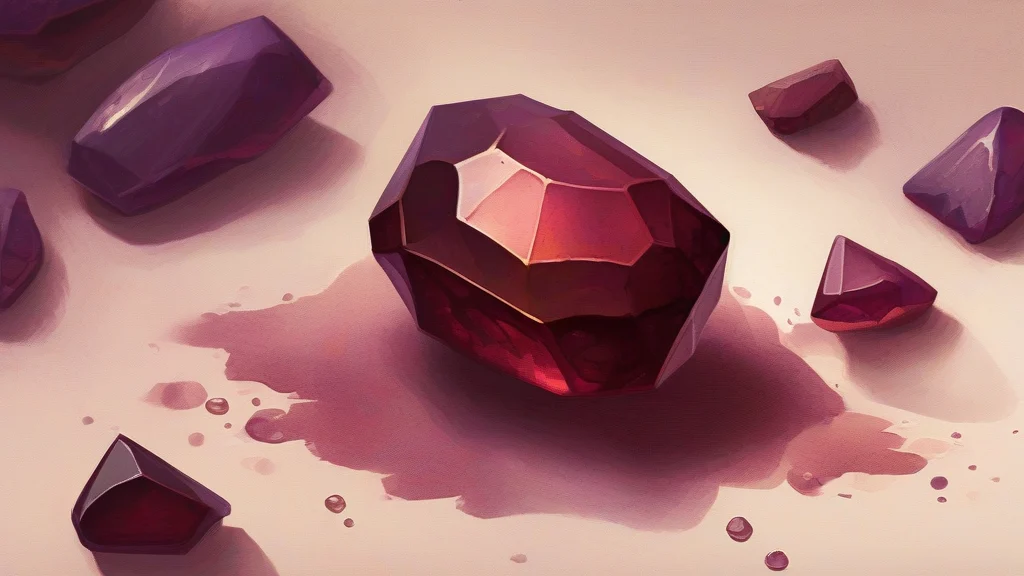
Almandine is the most abundant member of the garnet family, a deep red to violet-red iron aluminium silicate mineral valued both as a gemstone and as an industrial abrasive. Its name derives from Alabanda, an ancient city in Asia Minor long associated with cutting and trading these stones. In jewellery it appears in rings, brooches, and Victorian mourning pieces, sometimes showing a four- or six-rayed star effect known as asterism when cut en cabochon. Because of its considerable hardness and sharp-edged fracture, crushed almandine is also widely used in sandpaper, blasting media, and waterjet cutting. The term belongs chiefly to the vocabulary of gemmology, mineralogy, and antiques dealing, and the closely related spelling 'almandite' denotes the identical mineral. Distinguishing almandine from similar red gems such as pyrope requires attention to its characteristic violet undertone.
nounA deep violet-red variety of garnet, an iron aluminium silicate mineral widely used as a gemstone and as an abrasive.
- The deep red to violet-red iron aluminium garnet mineral, prized as a gemstone.
- The same mineral in its industrial role as a hard abrasive, used in sandpaper and blasting media.
"The antique brooch was set with a large cabochon-cut almandine that glowed wine-dark in the lamplight."
"Her engagement ring held a star almandine whose four-rayed asterism shifted as she turned her hand."
"Crushed almandine is a common abrasive in waterjet cutting because of its hardness and sharp fracture."
The plural is regular and typically used when referring to multiple gemstones or specimens.
"The tray displayed a dozen small almandines recovered from the river gravels."
Almandine takes its name from Alabanda, an ancient city in Asia Minor where the gem was once cut and traded — a jewel named after a town.
Reviewed by Deb Chak, Editor. AI-assisted content curated by RJS Tech Solutions LLP.
Etymology of almandine
Almandine entered English in the late medieval period via Latin 'alabandina', a name recorded by Pliny for a gem supposedly found near Alabanda, a town in ancient Caria (modern Turkey). The place name itself may derive from a Hittite or Carian personal name. Over time the spelling evolved through forms such as 'alabandine' and 'almandine', with 'almandite' emerging as a standard mineralogical variant. The word's history thus ties a common garnet directly to one specific ancient trading centre.
Related word forms
How almandine is actually used
Almandine is primarily a technical, lapidary, and jewellery term rather than everyday vocabulary. It appears most often in gemmology, mineralogy, and antique-jewellery contexts; 'almandite' is an accepted alternate spelling of the same mineral.
Easily confused with almandine
Pyrope is a magnesium aluminium garnet that is blood-red without the violet tint characteristic of almandine.
Hessonite is a cinnamon-orange variety of grossular garnet, not the deep red iron-rich garnet called almandine.