What does amethyst mean?
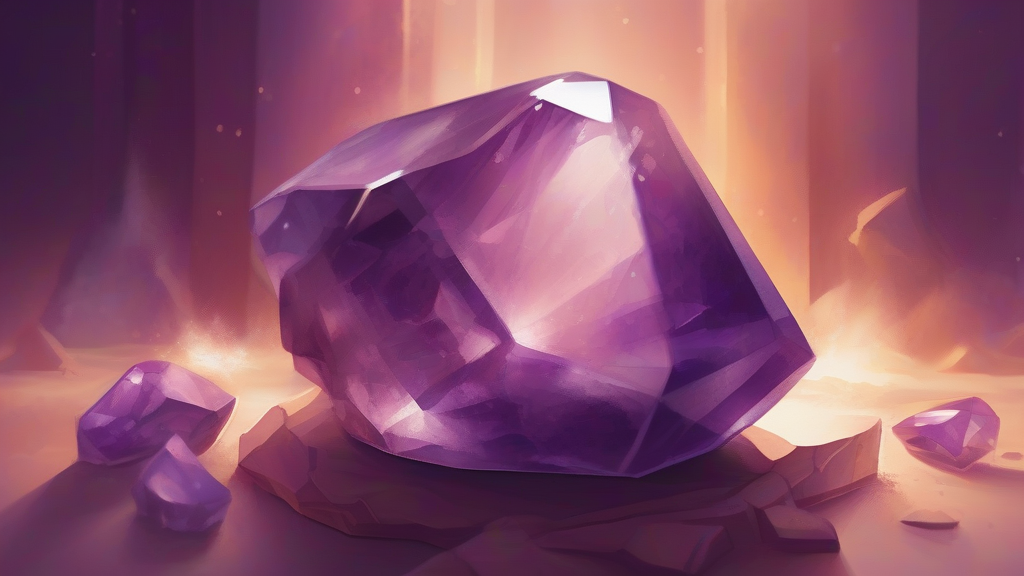
Amethyst is a violet-purple variety of quartz, prized for centuries as a gemstone and widely used in rings, necklaces, earrings, and other jewellery. Its colour ranges from pale lilac to deep royal purple, with the richest Siberian-style stones historically the most valued. The name descends from the Greek 'amethystos', meaning 'not drunk', reflecting the ancient belief that the stone protected its wearer from intoxication — a lore that made it a favourite for wine cups and signet rings. Beyond its mineral sense, 'amethyst' also serves as a colour term describing a soft bluish purple, appearing in fashion, interior design, and art. The stone is the traditional birthstone for February and has long been associated with clarity of mind, sobriety, and calm. Durable, affordable relative to other fine gems, and strikingly coloured, amethyst remains one of the most familiar and beloved gemstones in the world.
nounA precious or semi-precious gemstone, a violet-purple variety of quartz, used especially in jewellery.
- A violet-purple variety of quartz, cut and polished as a gemstone.
- A moderate bluish-purple colour resembling that of the gemstone.
"She wore a silver pendant set with a single deep-violet amethyst."
"The bishop's ring bore a large amethyst set in gold."
"She painted her bedroom walls a soft amethyst that glowed at dusk."
The plural 'amethysts' is standard when referring to multiple stones; the singular is far more common in ordinary usage.
"The necklace was strung with dozens of small amethysts."
The ancient Greeks believed amethyst protected its wearer from drunkenness — the name literally means 'not intoxicated'.
Reviewed by Deb Chak, Editor. AI-assisted content curated by RJS Tech Solutions LLP.
Etymology of amethyst
Amethyst comes from the ancient Greek 'amethystos', meaning 'not drunk' or 'not intoxicated', formed from the negative prefix 'a-' combined with 'methystos', related to 'methy', wine. The Greeks believed the stone was a remedy against drunkenness, which is why it was carved into wine vessels. The word passed into Latin as 'amethystus' and reached English via Old French in the medieval period, becoming firmly established by the early modern era. It shares its ultimate connection to wine-related Greek vocabulary with words such as 'methyl'.
Related word forms
How amethyst is actually used
As a colour term, 'amethyst' describes a moderate purple with a slight blue cast; it appears mostly in design, fashion, and decorative contexts rather than everyday speech.