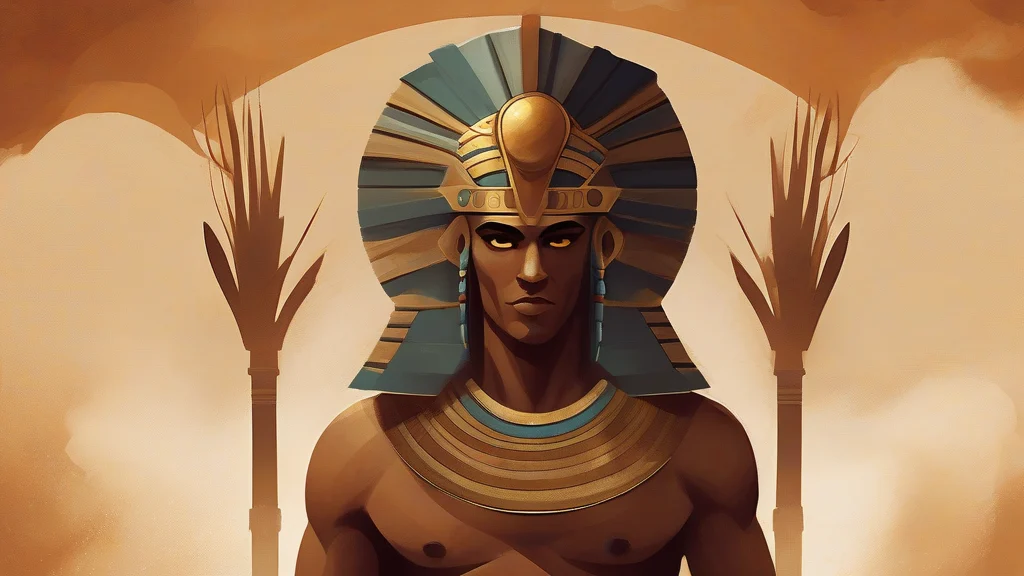
What does ammon mean?
Ammon is an alternative name — chiefly transmitted through Greek sources — for Amun, one of the most important gods of ancient Egypt. Originally associated with air and hiddenness, Amun rose to become the state god of the Egyptian empire, worshipped above all as the composite deity Amun-Ra, whose cult center at Karnak grew into one of the largest religious complexes ever built. The Greeks identified Ammon with their own king of the gods, Zeus, producing the hybrid figure Zeus-Ammon, often depicted with a ram's horns; Alexander the Great famously consulted his oracle at Siwa Oasis. The god's name also lives on indirectly in modern vocabulary: minerals such as sal ammoniac gave their names to ammonia and ammonium compounds, and 'ammonites' were named for the ram-horn shape of the god. Today Ammon is encountered mainly in history, archaeology, and classical mythology rather than everyday speech.
nounAmmon is an alternative name for Amun, the major ancient Egyptian god associated with air, hiddenness, and creative force, who rose to supreme importance as Amun-Ra during the Middle and New Kingdoms. The Greeks identified him with Zeus under the name Ammon, spreading his cult across the Mediterranean world.
- An alternative name for Amun, the ancient Egyptian creator and sun god, worshipped especially as Amun-Ra and later equated by the Greeks with Zeus.
"The oracle of Ammon at Siwa was famous enough that Alexander the Great made the desert pilgrimage to consult it."
"Karnak temple remained the grandest center of worship of Ammon for well over a thousand years."
"Classical writers referred to the Egyptian supreme god as Jupiter Ammon, merging him with their own Zeus."
"Coins minted in ancient Cyrene bore the horned head of Zeus Ammon."
Alexander the Great trekked across the Libyan desert just to ask a question at the oracle of Ammon — and left convinced he was the god's son.
Reviewed by Deb Chak, Editor. AI-assisted content curated by RJS Tech Solutions LLP.
Etymology of ammon
Ammon derives from the ancient Egyptian god Amun (also transliterated as Amen), whose name is conventionally interpreted as meaning 'the hidden one.' The form 'Ammon' entered Western usage through Greek, which adopted the deity during periods of contact between Egypt and the Mediterranean world and equated him with Zeus as Zeus-Ammon. From this name come several enduring English words: 'ammonite' fossils were named after the ram-horned image of Jupiter Ammon, and 'ammonia' traces back through sal ammoniac, a salt historically obtained near the temple of Ammon in Libya. The ram itself became sacred to the god largely because of this Greek-Egyptian identification.
Related word forms
How ammon is actually used
Ammon appears almost exclusively in historical, archaeological, and mythological contexts. It is a proper noun and is typically capitalized. In modern scholarship, the Egyptian form 'Amun' or 'Amen' is often preferred, while 'Ammon' reflects Greek and Roman usage.
Easily confused with ammon
Amun is the original Egyptian form of the god's name, while Ammon is the Greek-derived rendering that became common in classical and later European usage.
Ammonia is a chemical compound of nitrogen and hydrogen; its name ultimately derives from the god Ammon via sal ammoniac, but the two words have entirely different meanings.