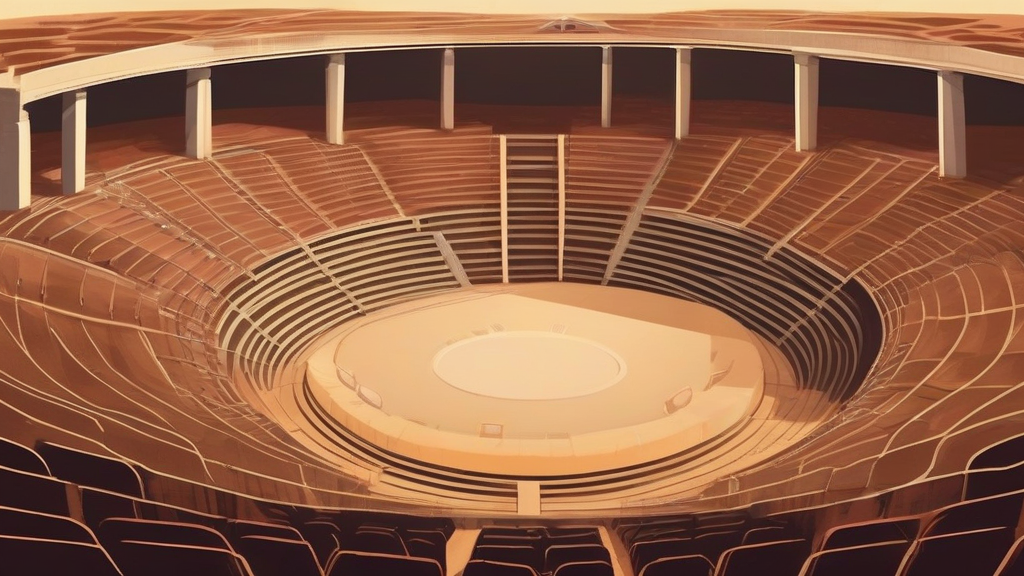
What does amphitheatre mean?
An amphitheatre is an oval or circular open-air structure with tiers of seats rising steeply around a central arena, designed so that spectators can view events from all sides. The form was perfected by the Romans, who used amphitheatres for gladiatorial contests, wild-beast hunts, and public spectacles; the Colosseum in Rome remains the most celebrated example. In modern usage the term extends beyond antiquity to describe contemporary open-air venues with raked or tiered seating facing a stage, as well as natural bowl-shaped landforms — carved by glaciers or erosion — that resemble these structures. The word derives from Greek roots meaning 'on both sides' and 'viewing place', reflecting its all-around design. Amphitheatres evoke grandeur, spectacle, and communal gathering, whether in ruined stone or sunlit hillside.
An oval or circular open-air venue with tiers of seats rising around a central arena, used in antiquity for gladiatorial contests and public spectacles.
"Tourists gathered in the ancient amphitheatre at Nîmes, imagining the roar of the Roman crowd."
In British English spelled 'amphitheatre'; in American English usually 'amphitheater'.
Any modern open-air venue with tiered seating arranged around or facing a performance area, or a natural bowl-shaped hollow of land resembling such a structure.
"The band played to a sold-out crowd at the Red Rocks amphitheatre."
Often applied figuratively to scenic landforms, e.g. a glacial cirque described as a 'natural amphitheatre'.
In British English the plural is 'amphitheatres'; American English uses 'amphitheaters'. Both are regular plurals.
"The region is dotted with well-preserved Roman amphitheatres."
The Colosseum — history's most famous amphitheatre — could seat around 50,000 Romans, and some arenas could even be flooded to stage mock naval battles.
Reviewed by Deb Chak, Editor. AI-assisted content curated by RJS Tech Solutions LLP.
Etymology of amphitheatre
Amphitheatre comes from Latin 'amphitheatrum', borrowed from Greek 'amphitheatron', a compound of 'amphi-' ('around, on both sides') and 'theatron' ('place for viewing', itself from 'theasthai', 'to behold'). The Greek compound described the semicircular seating of early theatres, but the Romans applied it to their fully enclosed oval arenas. The word entered English in the late Middle Ages via Latin, with the spelling 'amphitheatre' standard in British English and 'amphitheater' in American English. Cognates sharing the 'amphi-' root include amphibian and amphora.
How amphitheatre is actually used
The spelling 'amphitheatre' is standard in British English; American English typically uses 'amphitheater'. The word carries connotations of antiquity and spectacle when applied to Roman structures, but is neutral-to-pleasant when describing modern outdoor venues or scenic landforms. The plural is amphitheatres (British) or amphitheaters (US).
Easily confused with amphitheatre
A theatre is a building with a stage at one end for dramatic performance, whereas an amphitheatre is a round or oval arena with seats on all sides surrounding a central space.
A stadium is typically an elongated U-shaped or rectangular sports venue with a running track or pitch, while an amphitheatre is fully enclosed in an oval or circle around a central arena.