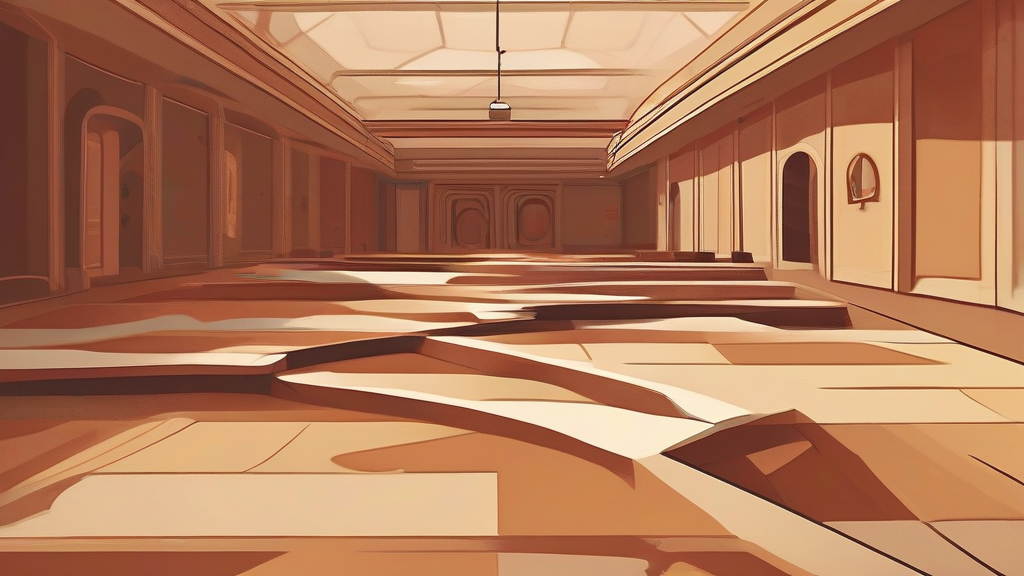
What does anamorphosis mean?
Anamorphosis is a noun referring to a deliberately distorted image or projection that resolves into a recognizable, proportionally correct picture only when seen from a specific vantage point or through a device such as a cylindrical mirror. The technique flourished in Renaissance and Baroque art, where painters concealed hidden figures within otherwise ordinary compositions; Hans Holbein the Younger's anamorphic skull in 'The Ambassadors' (1533) is the most celebrated example. In modern times, anamorphosis thrives in street art and advertising, where pavement paintings appear three-dimensional to passers-by standing in the right place. The term also carries a secondary, more technical sense in biology and geology, denoting a gradual transformation of one form into another. Derived from Greek roots meaning 'to transform back', the word lends itself naturally to discussions of perspective, illusion, and perception. Its adjective, 'anamorphic', is widely known from cinema, where anamorphic lenses compress wide images onto standard film frames.
A distorted image or projection that appears normal or correctly proportioned only when viewed from a particular angle or with the aid of a special device such as a curved or cylindrical mirror.
"The gallery displayed a striking anamorphosis that revealed a portrait only when reflected in a polished cylinder placed at its centre."
This is the dominant sense today, especially in discussions of art, perspective, and visual illusion.
A gradual transformation or evolution of one form into another, used chiefly in biological and geological contexts.
"The fossil record documents the slow anamorphosis of early marine organisms into land-dwelling species."
The plural follows the standard Greek-derived pattern for words ending in '-osis', changing to '-oses'. It remains rare in general writing but appears in scholarly treatments of visual art.
"The exhibition gathered anamorphoses from across Europe, spanning three centuries of optical experimentation."
Holbein hid a skull in his 1533 painting 'The Ambassadors' using anamorphosis — it looks like a smear until you stand to the side, and it's been unsettling viewers for nearly five centuries.
Reviewed by Deb Chak, Editor. AI-assisted content curated by RJS Tech Solutions LLP.
Etymology of anamorphosis
Anamorphosis derives from the Greek 'ana-' (meaning 'back' or 'again') combined with 'morphosis' (meaning 'forming' or 'shaping'), which itself comes from 'morphē', meaning 'form'. The word entered English usage in the early seventeenth century, coinciding with renewed scholarly interest in perspective and optical illusion. It shares its Greek root with cognates such as 'metamorphosis', 'morphology', and 'amorphous'.
Related word forms
How anamorphosis is actually used
Anamorphosis is a technical term used mainly in art history, optics, and visual theory; it is uncommon in everyday conversation. The adjective form is 'anamorphic', familiar from cinema in phrases like 'anamorphic lens' and 'anamorphic widescreen'.
Easily confused with anamorphosis
Metamorphosis is a complete physical transformation of form (as in a caterpillar becoming a butterfly), while anamorphosis is a deliberately distorted image that looks correct only from a specific viewpoint.