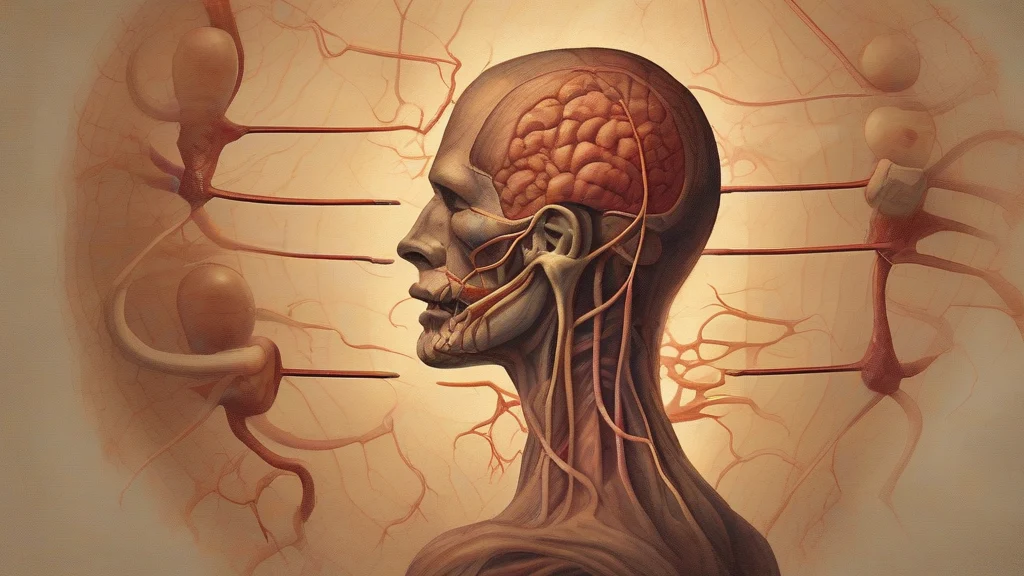
What does anastomosis mean?
Anastomosis refers to a connection formed between two channels that are normally separate — most commonly blood vessels, but also loops of intestine, lymphatic vessels, plant veins, fungal hyphae, and even branching river channels. In surgery, creating an anastomosis means surgically joining two open ends so that fluid can flow through them continuously, a procedure essential after removing a section of bowel or bypassing a blocked vessel. In nature, anastomoses act as built-in redundancy: because arteries interconnect, blood can often find an alternate route when one pathway is obstructed. The word comes from Greek roots meaning 'to furnish with a mouth' or opening, reflecting how the joined channels open into one another. It is a technical term, encountered mainly in medical, biological, and geographical writing, and it carries no strong connotations beyond its precise descriptive function.
A connection created naturally or surgically between two tubular or channel-like structures, especially blood vessels or sections of the digestive tract, allowing flow between them.
"The cardiologist explained that collateral anastomoses had formed, allowing blood to bypass the narrowed coronary artery."
Plural: anastomoses. In clinical contexts the adjective form 'anastomotic' is common, e.g. 'anastomotic leakage'.
In botany, mycology, or geography, a cross-connection linking parallel veins, hyphae, or stream channels into an interwoven network.
"The leaf's venation showed extensive anastomosis, with minor veins looping and rejoining throughout the blade."
Follows the Greek-style plural in '-es' pronounced /siːz/, standard in both British and American medical English.
"Numerous small anastomoses were visible between the branches of the mesenteric arteries."
Your body is full of built-in detours: thanks to natural anastomoses, blood can reroute around a blocked artery like traffic around an accident.
Reviewed by Deb Chak, Editor. AI-assisted content curated by RJS Tech Solutions LLP.
Etymology of anastomosis
The word anastomosis derives from Greek 'anastomoûn' ('to provide with a mouth'), formed from 'ana-' ('up, back') plus 'stoma' ('mouth, opening'). It passed into Latinized scientific vocabulary and entered English in the mid-sixteenth to early seventeenth century through anatomical literature, where it described the intercommunication of blood vessels. Its sibling terms include 'stoma' itself and, more distantly, 'stomach', which shares the Greek root for mouth-like openings. The related verb 'anastomose' and adjective 'anastomotic' developed later within medical usage.
Related word forms
How anastomosis is actually used
Anastomosis is a formal, technical term used chiefly in medicine, surgery, anatomy, and biology; it rarely appears in everyday conversation. Pluralization follows the Greek pattern 'anastomoses' rather than 'anastomosises'. The verb form is 'anastomose', and the adjective 'anastomotic' appears frequently in clinical descriptions such as 'anastomotic leak'.
Easily confused with anastomosis
Osmosis is the diffusion of a solvent through a semipermeable membrane, whereas an anastomosis is a physical connection between two channels such as blood vessels.
Homeostasis refers to the body's maintenance of stable internal conditions, while an anastomosis is a structural joining of vessels or passages.