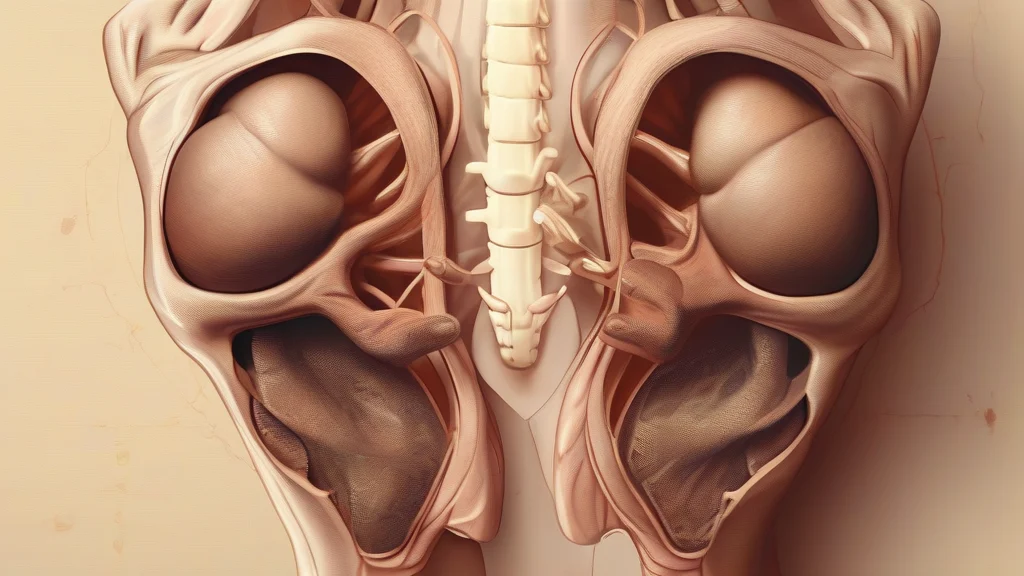
What does anatomically mean?
"Anatomically" is an adverb used to describe something in terms of bodily structure — the parts of an organism and how they are arranged. It derives from the Greek-rooted noun "anatomy," which entered English via Latin, and it serves as the adverbial form of the adjective "anatomical." The word appears most often in scientific, medical, and educational contexts, where precision about physical structure matters: researchers may describe fossil remains as anatomically modern, surgeons may compare two patients' anatomy, and illustrators may be praised for producing anatomically accurate drawings. In everyday usage it survives mainly in the fixed phrase "anatomically correct," applied to dolls, models, and depictions that faithfully represent real bodies. Its connotations are neutral and technical rather than emotional. Closely related but distinct is "physiologically," which refers to how body parts function rather than how they are structured. For anyone reading medicine, biology, palaeoanthropology, or even product reviews, "anatomically" is a small word that signals rigour and structural accuracy.
adverbIn a way that relates to the structure of the body or of an organism; with reference to anatomy. Used to describe something as it exists or is considered from the standpoint of bodily structure.
- With respect to the structure of the body or an organism: describing something in terms of its anatomical features or arrangement.
- Conforming to or consistent with the actual structure of the body, especially in depictions, models, or descriptions (as in 'anatomically correct').
"The two bones are anatomically distinct, though they perform similar functions."
"Modern humans have been anatomically modern for roughly 300,000 years, though their behaviour continued to evolve."
"The medical illustrator ensured every figure in the textbook was anatomically accurate before publication."
The phrase "anatomically correct" is so entrenched that dolls, drawings, and even dinosaur toys are graded by it — a rare case where a technical adverb became a consumer label.
Reviewed by Deb Chak, Editor. AI-assisted content curated by RJS Tech Solutions LLP.
Etymology of anatomically
The word traces back through the adjective "anatomical" to the noun "anatomy," which English borrowed from Latin "anatomia," itself taken from Greek "anatome," meaning "dissection" — literally "a cutting up" (from "ana-" (up) + "tomē" (a cutting)). Because dissection was the original method of studying bodily structure, the term has carried the sense of structural examination since antiquity. "Anatomically" formed regularly from "anatomical" using the adverbial suffix "-ly," and has been in use since at least the early modern period alongside the growth of scientific anatomy.
Related word forms
How anatomically is actually used
A formal, technical word found chiefly in scientific, medical, and educational writing. In everyday speech it appears most often in the fixed phrase "anatomically correct," applied to models, illustrations, and figures. It carries no emotional connotation; tone is neutral and descriptive.
Easily confused with anatomically
"Anatomically" concerns physical structure (the parts and their arrangement), while "physiologically" concerns function — how those parts work.